Wednesday, December 5, 2018

WHAT MADE THE GREATEST COACH IN ANY SPORT?


John Wooden was probably the greatest coach in any sport. How did he do it? Better said, what conditions formed a person like him, and what made the record-setting teams he coached?  Are his methods a formula for success in any realm, or any sport?

Wooden said winning is a byproduct of something else. That is probably true, but records of winning in competition give an easy and objective way to measure greatness as a coach. Wooden’s records in basketball at UCLA are at the best in any team sport: 10 NCAA national championships (in a peak period of 12 years); an 88 game winning streak covering almost 3 years; a 38 game winning streak in NCAA tournaments against the highest competition. Comparisons with other coaches and other sports are complicated:  winning streaks, frequency of championships, winning percentages, all need to be combined, taking into account differences in level of competition. Top coaches are those who win consistently, against whoever, and are at their best in big games against the strongest opponents. (See Appendix for Wooden’s record compared to other big winners.)

Wooden’s coaching methods

Bill Walton described team practices at UCLA as “non-stop action and absolutely electric, super-charged, on edge, crisp, and incredibly demanding, with Coach Wooden pacing up and down the sideline like a caged tiger, barking out instructions, positive reinforcement and appropriate maxims: ‘Be quick, but don’t hurry’... ‘Discipline yourself and others won’t need to.’

“He constantly moved us into and out of minutely drilled details, scrimmages, and patterns while exhorting us to ‘Move... quickly... hurry up!’ ... In fact, games seemed like they happened in a lower gear because of the pace at which we practiced. We’d run a play perfectly in scrimmage and Coach would say, ‘OK, fine. Now re-set. Do it again, faster.’ We’d do it again. Faster. And again. Faster. And again. “I’d often think during UCLA games, ‘Why is this taking so long? because we had done everything that happened during a game thousands of times at a faster pace in practice.’

“When four guys touched the ball in two seconds and the fifth guy hit a lay-up, man, what a feeling! When things really clicked, the joy of playing was reflected by the joy on (Wooden’s) face. He created an environment where you expected to be your best and outscore the opponent; where capturing a championship and going undefeated was part of the normal course of events.” [Wooden and Jamison, viii-ix]

Practice was more central than the game. After Wooden retired, when people would ask him what he missed, he said “I miss the practices.” [108]

Wooden’s formula was: don’t think about winning; strive for the best performance you can produce by maximal effort in practice.

This meant focusing on the tiniest details that would give you an advantage. When players first arrived at UCLA, weeks before practice began, Wooden would assemble them and demonstrate how to put on your socks so as to avoid wrinkles-- the aim being to prevent blisters. It was a group ritual: Wooden would demonstrate putting on his socks, then have every player demonstrate it to him. Same with how to tie the laces and measuring to get exactly the right size basketball shoes. [60] Wooden’s writing rarely goes into the details of more substantive skills and team drills, probably thinking there was no need to give this away, and anyway it had to be done physically at the proper rhythm. *

* Wacquant [2004] makes a similar point about practicing in a boxing gym: everything could be done alone at home except sparring, but doing stomach-building sit-ups, skipping rope, punching the light and heavy bags was more motivating when it was done together in the gym in 3-minute rounds punctuated by the trainer ringing a bell.

Team above star.  Not only does team play come first. Stars who show off or “get too fancy” are distractions from team coordination and maximal effort on everyone’s part. Wooden comments that Lew Alcindor [Kareem Abdul-Jabbar] could have set college scoring records (as he did in the pros), but he understood that it would have reduced team play. Disciplining newly arriving stars was crucial, and Wooden said that the coach’s best ally in this respect was the bench: benching a star during practice or even a game is the best way to get the point across, and the other players see it and play harder. [128]

Wooden’s team-above-star method ran directly against the main pathway by which young basketball players first make their reputation. Scott Brooks [2009] has shown in analyzing teen basketball leagues in Philadelphia-- the breeding grounds for players recruited by colleges all over the country-- a young player could only make a reputation by scoring a lot of points, and this meant getting the ball as often as possible. It was a cumulative spiral, both up and down: if a player scored a lot, he could demand the ball more; if he couldn’t get the spiral going, he wouldn’t have the opportunity to show his skills. Wooden thus had to break the prevailing style of play, especially as basketball became desegregated in the 1960s and the sport jumped in popularity. Probably he had an advantage in that his earlier teams did not emphasize shooters, big men, or fancy dribblers, but speed and passing. His signature player, Bill Walton, was described (when he won a championship in the pro ranks) as the greatest passing quarterback in the history of the NBA. 

Mistakes happen. This is inevitable. Wooden’s point is not to blame yourself, or blame others, but to analyze the situation, locate the mistake that is under your own control, and fix it. This means not getting emotional when bad things happen.

Controlling emotions was a key to Wooden’s methods. He did not believe is giving pep-talks, speeches to stir up emotion before big games. “If you need emotionalism to make you perform better, sooner or later you’ll be vulnerable, an emotional wreck, and unable to function to your level of ability.” Hatred and anger motivate only briefly. They aren’t lasting and won’t get you through the ups and downs of a game. “Mistakes occur when your thinking is tainted by excessive emotion... To perform near your level of competency your mind must be clear and free of excessive emotion.” [124-5] Top performance is being cool and professional. Micro-sociologically, this is high EE -- emotional energy as confidence and enthusiasm, the very words that Wooden uses. Not that it is emotionless-- Bill Walton speaks of the joyful feeling when a high-speed coordinated play involving the entire team clicks. This is a non-disruptive emotion, in the rhythm, not breaking it.

The coach’s job includes criticism, pointing out mistakes not as punishment by to correct them and get better results. “The only goal of criticism or discipline is improvement.” Above all, hard criticism in public is to be avoided, since it embarrasses and antagonizes players. Wooden’s strongest punishment was to take away the privilege of participating in a UCLA team practice. “If they weren’t working hard in practice I would say, ‘Well, fellows, let’s call it off for today. We’re just not with it.’ The vast majority of the time the players would immediately say, ‘Coach, give us another chance. We’ll get going.’” [118-19]

Playing under pressure against top competition, obviously, is the mark of a championship team. For Wooden, this was a by-product of long experience in his methods of practice. He also believed the most difficult experience would promote even higher effort--- not just as individuals or in bodily endurance but in the team rhythm. The apex was perhaps in the 1973 championship game when UCLA stretched its undefeated streak to 75 games and won the NCAA for the 7th year in a  row; Bill Walton made 21 of 22 field goal attempts.

Adversity of all kinds are to be taken as opportunities. After the 1966-67 season, the NCAA banned the dunk shot, in part because of 7 ft. 2 inch Lew Alcindor. Wooden encouraged him to get a new shot; it became his trademark skyhook, an unstoppable shot by a big man.

Wooden said that he scouted opponents less than other coaches. He wanted the focus to be on his own team, not on the other. What if they changed unexpectedly? He aimed at preparing for any eventuality, and believed that his team’s high-speed style was capable of attacking any defense. Tricks of psychological warfare weren’t worthwhile. Nevertheless Wooden had one that he always used: don’t be the first team to call a time-out. Let the other team admit they’re tired. His high-speed practices ensured his players would be in superior condition.

Wooden rated himself an average coach tactically; he said his advantage was in analyzing his players, and the fact that he enjoyed hard work. I would add: his hard work was producing intensely focused, high-speed, rhythmically entraining team practices: the definition of a successful Interaction Ritual. The hard work of an intense IR pays off in high EE.  Wooden certainly had it; and his players got it too.

Why Wooden?

Sociologically, our aim is not to make a hero or a genius out of Wooden, but to analyze how someone like this would appear when and where he did. John Wooden was born in 1910 in a small town in Indiana. He grew up in the 1920s in a basketball-crazed state, where high school games would attract more spectators than the entire local population. As a boy, Wooden idolized the famed state champion team, and became a star basketball player in high school and college. He was not tall or muscular (5 ft. 10 inches), but quick and fast, and he worked hard conditioning himself to become even better in the areas where he had an advantage. His coach at Purdue, where he was a three-year All American, said he was the best-conditioned athlete he had seen in any sport. He became famous for diving for loose balls on hardwood floors, hustling all the time and jumping back up like a rubber ball whenever he was knocked down by bigger players. In his final year at Purdue, he was named Player of the Year in a national poll.

Wooden’s technique as a coach was to make players as much like himself as possible.

He early became accustomed to team success. His high school team won the Indiana championship in 1927 and lost the final game in 1928 by a last minute shot at the buzzer. At Purdue, his 1932 team was voted national champion (NCAA tournaments did not exist until 1941).

Nevertheless, top success as a coach took considerable time. When Wooden won his first NCAA championship at UCLA in 1964, he was 54 years old; his last came in 1975, when he was 65. After graduating from college in 1932, he played in a local professional league for 6 years, simultaneously teaching high school English and coaching the basketball team. Not counting 3 years in the army in WWII, Wooden coached high school for 11 years, winning state championships and compiling a record of 218-42 (winning 84%). At age 36, he became the basketball coach at Indiana State Teachers College (now Indiana State University), as well as Athletic Director, where he won the state championship both years he was there. In 1948 (now age 38) he was hired to coach UCLA, at the time a mediocre team. He turned the team around immediately and began a string of winning seasons, but it was 16 years before UCLA’s first NCAA championship. By 1961-2 and 62-3, his teams were winning the Pacific Coast Conference, and finished 4th nationally both years. Apparently they were on the brink of dominance.

Why did it take so long? Wooden taught the same methods throughout his years at UCLA, and declared that he put out the same amount of effort. The spiral of success and reputation was moving in his favor; Wooden was attracting better players nationally.  A second factor was the opening at just this time of the era of black basketball players. In the 1964 championship game, UCLA beat Duke, even though they had two players near 7 ft. and Wooden had no-one taller than 6 ft. 5. But Duke was still in the era of segregation, and UCLA’s integrated team of fast ball-handlers beat the big slow white guys. Soon after, Lew Alcindor arrived from the Bronx. (Freshmen were not allowed to play varsity, so Alcindor did not join the mix until the 1966-67 season.) Wooden had been a pioneer of supporting black players since his coaching days at Indiana State, where he refused a post-season invitation in 1947 because the then-ruling National Association of Intercollegiate Basketball maintained segregation to mollify its southern members. Next year, when Wooden’s team again won the Indiana championship, the NAIB reversed its ban on black players, and Wooden’s player Clarence Walker became the first black to play in a post-season tournament. Wooden’s team reached the final but lost-- the only championship game he would ever lose.

After 1965, everything was rolling in the positive spiral of feedback and social momentum, setting the stage for the unmatched championship streak.

Wooden says he decided to retire, suddenly after a Final Four victory in 1975, putting UCLA in the championship game for the 10th time. He recalled walking from the floor, thinking of the crowd of reporters he would have to face with the same, boring questions. He was 65; he had been playing and coaching at high intensity for 50 years. He had broken every record and then broken them repeatedly. Is there a turning-point from the peak of EE? His team had been on a plateau for the last several years. Or was it that Wooden finally decided that the victory-crazed fans and reporters never would understand what he was about? 

He did not disappear from the public eye, but turned to publicizing his methods of success, as universally applicable, not just to sports but to business, professions, life in general.

Do the same methods succeed elsewhere?

Wooden’s methods (team not star, attention to details, high-energy practices, professionalism not emotion, maximal speed in rhythm) worked extremely well in basketball. But not all great basketball teams use them; in other sports, some champions do, some don’t. Further afield, do these principles succeed in other career fields, in business and politics, art and intellectual life?

Basketball and other team sports have a similar range of coaching styles. Some successful coaches were dictatorial, including Vince Lombardi in the NFL and Bobby Knight in college basketball, known for win-at-any-cost (and the latter) for angry tirades against players and referees. The best winning record among college football coaches (88%) was Knute Rockne at Notre Dame in the 1920s, and he was famed for his inspirational oratory at halftime. This was probably a carryover from the public oratory ubiquitous throughout the 19th century, at a time when college football became the big public entertainment. As time went on, the analytical approach promoted by Wooden tended to supplant or at least complement emotional oratory. But we lack good comparative study on different coaching methods vis-à-vis their results in winning records.

Wooden’s unconcern with scouting opponents has certainly not carried the day. His rationale of concentrating on what we do well and not making the enemy the prime focus was a way of living inside the ritual zone-- better yet the center of a whirlwind-- that he created in intense practices. But scouting became a major part of team organization, above all once football coaches (led by pro coach Sid Gilman in the 1960s) began using newsreel film to analyze opponents. This has expanded into a huge industry with TV broadcast tapes and every team’s own digital cameras and a large staff to break out the patterns. Devising strategies has tended to supplant spontaneous application of well-drilled skills; the use of statistical analysis in baseball strategy in the 2010s is blamed for making games duller. Does Wooden’s caveat still apply? -- getting caught up in focusing on your enemy can backfire. Probably.

Focus on crucial details that make up athletic skill is unquestionably a key to success. Was Wooden overcontrolling in this respect? Not only did he have his players concentrate on details, he was obsessed with them. Wooden and his assistants spent more time each morning planning the afternoon practice than the 2 hours or less actually spent on the court. They made detailed lists, down to the minute for time to be spent on each drill, even specifying how many basketballs should be placed where for what drill. Wooden also kept detailed records after practice of how it went, so he could chart individual players' progress and focus on individualized drills as needed. [133] The value of all of this detail-compiling would have to be settled by comparisons; probably it was Wooden’s way of keeping himself running at full bore at all times, when he wasn’t in the buzz of directing practices.

In individual sports, the role of the coach declines or at least becomes less prominent. The most successful athletes in areas like tennis and swimming are famed for their own self-discipline. Bill Tilden, who dominated men’s tennis during the 1920s (ranked number one player in the US 11 years in a row, 8 years as world champion), wrote about his own methods: the keys were to observe carefully, to anticipate the opponent’s moves and the flight of the ball, and to establish emotional domination. He would watch an opponent warming up, looking for his favorite and least-favorite shots; then he would attack his weaknesses; occasionally when playing an especially strong opponent, he would attack his strengths to deflate his confidence. Tilden carefully observed the angle of the racket so that he could tell which way the ball was going even before it was hit; and he moved immediately to the spot, not where the ball would bounce, but where he could hit it with his own body in prepared position. The focus on detail fits Wooden’s methods, although Tilden was more focused on the opponent -- probably inevitably in the back-and-forth rhythm of tennis. Tilden commented that luck plays less role in tennis than in any other sport, so skill wins out consistently. But it was skill, not brute force: he disparaged the hard-hitting serves of the younger players that he called “the California game,” and was consistently able to beat them. All this resembles Wooden. So was his central maxim, concentrating one’s attention during play: “The man who keeps his mind fixed on his match at all times puts a tremendous pressure on his opponent.” [Tilden, 13] Winning against equally concentrated opponents is a battle of wills-- a battle of self-discipline as Wooden would describe it.

Dan Chambliss [1989] developed a theory of winning and losing based on studying swimmers at different levels of competition, from local club up to the Olympic team. Winners are those who perfected the details that go into swimming faster (exact hand angles, timing of turns on the wall) an ensemble of techniques that add up little advantages into superior speed. Chambliss noted that winning swimmers do not practice longer hours or put in more effort than their also-ran competitors. It is not that they practice more; they practice better. And they enjoy their practice, since it gives them a sense of being in rhythm with oneself, a zone where effort is eclipsed by smoothness and purpose. Wooden would agree: feel yourself performing your best skills, and winning comes as a by-product.

Chambliss denied that the winning difference is just innate bodily strength or muscle quickness; the same swimmer could make a quantitative leap in competitive level, once he or she acquired the ensemble of skills and the mind-set to use them. *  Opponents think the habitual winner has something special, which they can’t define in physical terms; hence they tend to put the winner into a higher realm of existence. They think that the top rank must be something alien to their own experience, and thereby put themselves in an inferiority zone of lesser confidence. But there is nothing mysterious about winning-- in sports or anything else, Chambliss argues; writer’s block is a version of psyching oneself out by comparing oneself with the company of unreachable great writers. Excellence is the ability to maintain a normal, habituated attitude to being in the inner circle, just performing one’s detailed techniques. Thus Chambliss’s title: “The Mundanity of Excellence.”

* This happened to Tilden. He was interested in tennis since age 6, but for a long time was a klutzy player despite hanging out at a tennis club near his home. By the time he was 26 -- following 20 years of sharpening his observations of what makes good tennis -- he became unbeatable.

With team sports, we can make comparison between the success of a coach like Wooden and his successors. After Wooden retired, UCLA remained a good team but no longer a dominant one. And this was so even though UCLA was coached by Wooden’s former assistants and players. Presumably they followed the same methods of practice and so forth. This would appear to undercut the importance of the methods per se; Wooden himself must have added an extra something to them-- just more calm? more professional balance, combined with the right amount of detached intensity? But there are other reasons why a coach’s winning methods do not guarantee unending success. For one thing, his assistants become coaches elsewhere, propagating the techniques and raising the level of competition. This happens to all successful coaches, in all sports. Bill Walsh at the San Francisco 49ers taught a dozen assistants who spread the West Coast Offense throughout the NFL; eventually assistants of former assistants made up a network of almost the entire league. When a field of competitive method becomes saturated in this way, there are moves to break the mold by starting some new style of coaching.

Wooden’s methods outside sports

The closest analogy to team sports is war. William James said that we needed “a moral equivalent of war” -- i.e. a way to get the teamwork and group solidarity of wartime, without the casualties. When he wrote this, football was just beginning to become a popular college sport, and it created for its fans the tribal enthusiasm of war, with a better chance of joys and less devastating sorrows.

But the military art, for professionals, has many varieties of leadership. Taking the battlefield commander as the coach, do Wooden’s methods and maxims apply? One can find examples to fit, but we have no systematic comparisons. Some generals were famed for their oratory (Napoleon, Caesar); many made themselves deliberately into hero-figures with their own totemic emblems (Montgomery’s beret, Patton’s pearl-handled pistols, MacArthur’s corncob pipe, Eisenhower's jacket). Some led from the front, both as point man in the charge (Alexander the Great), or probing a high-speed blitzkrieg front (Rommel). Some were stern and dictatorial (Patton, Stonewall Jackson); some beloved by their troops (Robert E. Lee); some were just methodical and unflappable (Grant). There is no clear record of which styles did best; the question is confounded by historical changes in the size of armies and the technologies of war. Focusing on anticipating the enemy’s plans sometimes brings success, but also can lead to conservatism and loss of momentum, as Wooden warned (France at the Maginot Line). The tendency throughout the 20th century was to emphasize planning and logistics -- crucial for moving huge armies with many kinds of equipment; and in the 21st century huge staffs surround generals mapping out the sequence of projected choice points as a battle unfolds. The less resource-rich side reacts by avoiding settled battle lines and relying on tactics of guerrilla warfare -- a style which tends to promote charismatic leaders, whose personal reputation is a key to recruiting followers. On the whole, Wooden’s attention to detail holds true; but the other elements of his leadership style have no clear precedence.

The weakness of the war/sports analogy is that games are fundamentally different from real life.  Games are scheduled: we know in advance when and where they will take place. They have time limits; and referees to enforce rules and assess penalties. (In real war, the referees materialize after one side has decisively won, whereby they hold war crimes trials for the losers.) Above all, real life calls no time-outs; when military momentum flows and the more coherent war-organization has the other scattered and demoralized, wars are won by not letting the other side catch their breath. Schedules and time limits are exactly what are missing in war; it is sudden switches in time and place that are the art of military maneuver. War may resemble a scheduled game if there are fixed fronts, but this is the formula for unheroic carnage, war by attrition won by the side with the bigger battalions and industrial capacity to wear the other down. Evenly matched opponents in war resemble finalists in a championship tournament, but the result is not a good game but a disgusting one.

At the core of Wooden’s methods is the importance of  practices. And this fits sports in general, where there is far more practice time than game time. But this is another key feature of sports that does not fit most of real life. Yes, peace-time militaries spend much of their time drilling: marching around (a ritual irrelevant to modern battle), practicing firing weapons, war-games. But soldiers have found no substitute for the emotional atmosphere of war; and trained troops only acquire battle skills after a period in combat (if they do at all). It is true that set-piece battles are planned, in the Iraq wars as in past centuries; but this is generally a luxury of the resource-powerful side, who can wait until they are ready to launch an attack. On the macro-strategic level, planning is mostly table-top models (or today, computer simulations), since moving the full number of troops and weapons around a modern battlefield is far too large to be practical, and the experience is mainly worthwhile for the higher officers. Nevertheless they may find something left out of the plan-- the occupation of Iraq in 2003 was waylaid by unexpected mass looting of government installations, and by the fading away, not the surrender, of the defeated army with their weapons. Wooden would consider this an instance of over-relying on plans.

Business also lacks practices. Techniques exist for how to manage, and workers sometimes undergo training for a job; but it lacks the rhythm of sports-- intense practices with the coach pacing the sidelines, leading up to a short period of the game itself. Job-training programs are mostly failures; too remote from the cutting edge of work, too flat an atmosphere to have the skill-honing and motivational effects Wooden prized. Contemporary business corporations like to flaunt morale-building spaces and amenities for their workers; but these are chiefly a vacation from work, not the intense preparation of UCLA basketball.  In politics-- another area for which sports analogies are sometime touted-- a certain type of practicing for “the event” is now popular. Chiefly this takes the form of privately coaching a political candidate how to make speeches (complete with hand gestures and facial expressions) before the public and the press. But as the 2016 presidential campaign illustrates, politicians who need coaching tend to come across as artificial, and this hurts their impressiveness vis-à-vis candidates who seem more natural. Aside from this frontstage manipulation, one does not hear of practicing for the main work of politicians in office, which consists above all in negotiating coalitions. Despite superficial analogies (“Just win, baby!”) politics is not at all like sports.

Business is another area where analogies to winning in sports and in war are popular. Business schools and journalism are full of advice and theory of leadership. The preferred leadership styles change. In the era of the high-tech giants, charismatic leaders are in demand. Their charisma is orchestrated in product launches and other appeals to consumers-- a style set by Steve Jobs and emulated by Bezos, Ballmer, Musk, and others. The hope is that their charisma carries over to their cutting-edge products, or vice versa. But out-front charisma is not the only successful style. French sociologist Michel Villette shows that most of the great entrepreneurial fortunes made since the 1950s were created by ruthless competitors, stealing techniques and turf from oblivious or momentarily troubled rivals, and brazening out hardball lawsuits. Another style, far from supporting and uplifting one’s employees, is to set them against each other and cut the work force whenever their jobs can be absorbed by others, or by computers. A good deal of the rhetoric today about effectively managed corporations emphasizes good human relations, but this may be temporary in a time of expansion and relative labor shortage. One can only conclude that Wooden’s principles are not generally followed in the business realm, except for some of his more platitudinous maxims.

Bottom line

How does Wooden’s list hold up?

High energy practices, building up maximal speed and coordinated rhythm.  This is chiefly specific to sports.

Team not star.  On the other side is the popularity of charismatic leaders, in war, business, and politics. If they are too charismatic, they easily slide over into authoritarian despots. Team not star is good advice, but deviating from it is hard to avoid.  Outsiders (fans, investors, customers) tend to simplify everything down to an emblem. Audiences create the star.

Focus on perfecting your own action skills, not on scouting out the enemy. Even in sports, the shift has been entirely in the other direction. This is equally the case in business and the military.

Attention to the details that make up skill.  It is this “mundanity of excellence,” as well as “total concentration on the match” that divides insiders from outsiders.  Even charismatic leadership is a skill, and it involves learning not only oratory (although not necessarily) but being a careful observer of one’s audiences.  Emotional domination in conflictual situations is based especially upon careful observation of one’s opponent. This does not mean, scouting out the opposition in advance so that you follow a planned strategy, but quick, on-the-spot observation of emotional cues, finding the openings when domination can be achieved by setting the rhythm for the other to follow.

Cool professionalism rather than emotionalism. This is probably always valuable. How does it measure up in success compared with charismatic or cut-throat styles? A good sociologist could find this out.

Appendix: Highest-winning coaches and teams

The highest winning percentage for NFL coaches is .759 (John Madden with the Oakland Raiders 1969-78). But Madden won only 1 championship in 9 years (11%).  Best for both winning rate and  championships was .730 for Vince Lombardi (Green Bay Packers, 1959-69), with 5 championships in 10 years (50%).

Highest for college football coaches were .888 for Knute Rockne (Notre Dame, 1918-30); and Frank Leahy .864 (Notre Dame 1939-53). No national championship existed at that time.

Highest for NBA coaches is .705 for Phil Jackson, winning 11 championships (Chicago Bulls  1991-3, 1996-8, L.A. Lakers 2000-2, 2009-10).  Billy Cunningham is next at .698 (Philadelphia 76ers), but won only 1 championship. Red Auerbach had a .662 winning rate, and won 9 championships with the Boston Celtics, including 8 in a row 1959-66. No one else has more than 4 NBA championships.

For college coaches, John Wooden’s lifetime winning ratio (.804) is 5th on the list. Of those above him, the top is .833; these were coaches in minor programs except Adolf Rupp (Kentucky) at .822 with 4 NCAA championships. Wooden won the most championships (10), followed by Mike Krzyzewski  (Duke) at 5 (winning percentage .765).

Top coaches in women’s college basketball exceed the men’s coaches. Geno Auriemma has a .884 lifetime winning average at University of Connecticut, where he won 11 national championships between 1995 and 2016, including 4 in a row. Pat Summitt at University of Tennessee won .841 of her games, and 8 championships between 1987 and 2008, including 3 in a row. Summitt’s style differed strongly from Wooden’s, yelling at players, giving them icy stares for poor play, and generally considered one of the toughest coaches anywhere.

In Major League Baseball, top lifetime winning average was .615 by Joe McCarthy (Chicago Cubs 1926-30, New York Yankees 1931-46, Boston Red Sox 1948-50). He won 7 World Series, all with the Yankees, including 4 in a  row. Tied for World Series was Casey Stengel with 7 (all with the Yankees during 1949-60, including a 5-year victory string 1949-53; he previously coached the Brooklyn Dodgers and the Boston Braves, and subsequently the New York Mets). Stengel’s lifetime percentage was far down the list at .508 -- showing that quality of players makes a difference too. McCarthy was regarded as a passive, hands-off manager, letting his stars do their thing. (No John Woodens here.)

Winning streaks differ considerably by sport. Tops are 111 straight games won by Auriemma at UConn 2014-17 in women’s basketball; and 88 by Wooden at UCLA in men’s basketball. In the NBA, the longest streak was 33 games by the Lakers in 1971-2.

Longest winning streak in college football was 47 games, by Oklahoma in 1953-57, coached by Bud Wilkinson (winning percentage of .826, from 1947-63). In the NFL, the longest streak was 22 games, by the New England Patriots 2003-4. This seems around a natural ceiling; 8 NFL teams have had streaks of 18 or 19 games. The quality of the league is inversely related to the longest winning streak: longest in high school football (151 games by De La Salle H.S. in Concord, CA), 47 in college, 22 in the NFL.

In baseball, the longest winning streak is 22 games (2017 Cleveland Indians). In the National Hockey League, the longest streak is 17.

Putting together team streaks with lifetime coaching winning percentage and number of championships per years coached, these coaches stand out:

Geno Auriemma, UConn women’s basketball, .884, 111 game streak (top), 11 championships in 23 years (48%)
John Wooden .804, 88 game streak (top), 10 championships in 29 years (33%)
Phil Jackson, Bulls and Lakers, .705 (top for NBA), 33 game streak (top), 11 championships in 20 years (55%).
Red Auerbach, Celtics,  .662, 9 championships in 17 years (53%)
Pat Summitt, UTenn women, .841, 8 championships in 38 years (21%).
Vince Lombardi, Green Bay Packers,  .730, 5 championships in 10 years (50%)
Bud Wilkinson, Oklahoma football, .826, 47 game streak (top)
Bill Belichek, Patriots .681, 22 game streak (top), won 5 Superbowls in 28 years (18%)
Paul Brown, Cleveland Browns 1946-75, .672, won 7 championships in 29 years (24%)
Joe McCarthy, Cubs/Yankees/Red Sox, .615 (top for baseball), 7 championships in 23 years (30%)

There are others who were high in one area but not in others:
George Halas, Chicago Bears 1920-67, .667; won 6 championships over 47 years, for an average of 13%.
George Allen 1966-77, .712 (3rd highest in NFL history), but zero championships in 11 years.

There is no valid way of mechanically combining winning percentage, championships per year, and unbeaten streaks, to arrive at a mathematically ideal ranking of the most successful coaches. It could easily be devised, but the weights are subjective and arbitrary (as in college rankings, or corporate rating systems). Some coaches are better at one thing or another. It is what it is.

What should be done now is classify coaches at all levels of success by their coaching styles, the only valid test of whether any particular method makes a difference.


References

John Wooden and Steve Jamison. 1997. Wooden. A Lifetime of Observations and Reflections on and off the Court.

Scott N. Brooks. 2009.  Black Men Can't Shoot.  Univ. of Chicago Press.

Loic Wacquant.  2004.  Body and Soul.  Notes of an Apprentice Boxer.  Oxford Univ. Press.

Daniel F. Chambliss, 1989. "The Mundanity of Excellence." Sociological Theory 7: 70-86

Randall Collins and Maren McConnell. 2016.   Napoleon Never Slept: How Great Leaders Leverage Social Energy. Published as an E-book by Maren Ink.

William T. Tilden.  1950.  How to Play Better Tennis. A Complete Guide to Technique and Tactics.

Allen M. Hornblum.  2017.  American Colossus. Big Bill Tilden and the Creation of Modern Tennis.

Michel Villette and Catherine Vuillermot. 2009. From Predators to Icons: Exposing the Myth of the Business Hero. Cornell University Press.

Wikipedia articles: John Wooden; other coaches.

On-line records of coach and team winning percentages, championships, and streaks in basketball, football, and baseball.

Thursday, July 19, 2018

EDUCATIONAL CREDENTIAL INFLATION: AN INTERVIEW WITH RANDALL COLLINS


The following questions were posed by a Chinese on-line newspaper, The Paper [https://www.thepaper.cn]:


[The Paper:] 1. The Credential Society was published in 1979, but its Chinese edition has just come out. Therefore, I assume it is a good opportunity for you to review the days when you wrote it. So, after 39 years, do you still believe your observation and judgment of education and society? Has the educational system operated in the way this book presented in recent years?

Yes, inflation of educational requirements for jobs has increased quite a lot. In the US, the value of a 12-year (high school) diploma now is almost worthless for getting a job; it is only useful for entry into university to get a higher degree. Jobs that formerly had lower requirements, like police officer, now require a college degree, while a M.A. in Criminology or Criminal Justice is required to become a Police Chief. In the 1970s, when I wrote the book, a B.A. degree was becoming common for a job as a business manager; now most of these jobs require an MBA (as I  predicted). This has happened all across the spectrum of jobs.

[The Paper:] 2. Although the Credential Society focused on the U. S., it has been globally influential over the years. How do you evaluate its universal impact and value? In your opinion, is it applicable to other countries?

Credential inflation has become applicable world-wide in the last 30 or 40 years. The US began credential inflation earlier than most other countries; already by 1930 it had a higher percentage of university students and 12-year high school students; it started aiming for universal high school education in the 1950s, and now for universal university education. Russia (the old Soviet Union) and Japan were two other countries that developed mass high school and university systems early. Most European countries-- England, France, Germany-- had elite systems, with only a small proportion attending high schools (lycée, Gymnasium, etc.) and even smaller fractions attending university. They began to follow the US path of inflation in the 1960s and 70s, and then accelerated. Now many other countries-- for example, Chile, South Korea-- have pushed to a level where a large majority of the youth cohort attend universities; and it has become a major political demand-- how to provide free university education for everyone.

[The Paper:] 3. Since its publication, the Credential Society has caused persistent discussion. Has any relevant comment or discussion impressed you?

Originally my book was considered scandalous by many people. When I presented the original manuscript to my first publisher (University of California Press), they refused to accept it, even though it was under contract. A new publisher, Academic Press, published it, but then they refused to allow a mass paperback publisher (Anchor Books) to buy the rights to it, and Academic Press refused to issue it in paperback. So the book became hard to buy; and people would write to me to ask for a copy. Since it was written before the time of word-processing programs, the best I could do was send them a photo-copy. 

Over the years, the argument was known to specialists in sociology of education-- especially those with a more critical viewpoint; and several articles I had written on the topic were well known to students. The issue of credential inflation started becoming public after the 2008-9 financial crisis; and in the following years newspapers started carrying articles questioning whether a university degree is a good investment, because its value as a job payoff has fallen, while its cost has risen sharply.

[The Paper:] 4. What does this book mean to your academic career and your life? Has it influenced your other works?  

When the book was first published, I resigned my university position, because I felt it was wrong for me to work in the system that I had criticized. But the other books and articles that I published-- I worked in many other areas besides sociology of education-- resulted in receiving many job offers. I took a position that mainly consisted of doing research, and have published books that have had a good reception-- on sociological theory, creativity in intellectual networks, face-to-face social interaction, and sociology of violence. I stopped writing on credential inflation for many years, to work on other topics.

[The Paper:]  Are you satisfied with this book? If you were given a chance to rewrite it, would you like to make any modification or improvement?

To rewrite it now, I would need several research assistants to examine all the research that has been done of education and careers, education and its rising costs, education and social inequality. In general, the correlation between parents' social class and children's education has not changed from the 1930s through the present-- i.e. a huge increase in the percentage of children who go to high school, university, and advanced professional schools has gone up but stratification hasn't changed. The belief that more access to education would bring social equality has proven wrong.

On the theoretical side, the main thing that I would add to the book is to refine the concept of credential inflation as similar to monetary inflation. As economists have known for a long time, putting more money in circulation reduces the buying power of money. But the difference is, printing new money costs very little; and in the centralized banking systems we now have, it is possible to increase the money supply just by changing the procedures for making loans or to change the numbers in a computer. (This happens every day when the market value of a popular stock goes up.) But educational credentials are not just the paper that diplomas are printed on, but require much investment in school buildings, salaries for teachers and administrators, etc. Therefore: although monetary inflation theoretically has no limit, "printing" more educational degrees becomes very expensive when degrees are inflated and students spend more years of their lives in school. So the historical trend to inflate degrees goes through periodic crises-- either the students can't afford the degrees when their job payoff declines, or the government (or parents) can't afford to keep expanding the educational system. There was a mini-crisis like this in the 1980s, and again in the 2010s; and we can expect more such crises in the future. At some point, if 100% of the population is going to spend 20 or more years in school getting more and more advanced degrees, the cost of education becomes equal to almost the entire economy.

[The Paper:]  5. What research did you do for the book? What was the most challenging part when you wrote it?

Besides the theoretical analysis, I made two main research contributions. One was to assemble data to show how the job value of degrees has inflated during the 19th and 20th centuries in the US (the modern country that started credential inflation). I showed, for instance, that jobs as business managers required only high school degrees (or even less if one started as a family member or apprentice) until the 1950s. Surprisingly, even technical jobs-- engineers, the most essential technical job for modern industry-- was mostly learned by apprenticeship or on-the-job, rather than by formal education.  Traditionally in the West, lawyers and medical doctors, along with priests, were the main occupations that required university degrees; and even in these fields, people could learn these professions by apprenticeship. Abraham Lincoln, for instance, was a lawyer who never went to school, but learned law as an apprentice. The movement to require university and advanced degrees came in the late 19th century (in the US) and explicitly tried to make these fields more socially elite.

I would add here that if I were to revise The Credential Society today, I would add a section on how the big fortunes in the Information Technology area were made: Not by going to university to get a degree, but by dropping out of the university, to follow one's own innovations. This was the way the founders of Apple came to create the personal computer, and later the career paths by which Facebook, Google, and other digital empires were created.  (Apparently this is true in China, too, where the founders of Alibaba and Tencent were not academic stars, but failures in the exam system, who found experience in telecommunications work that gave them the idea of spinning off new products.) There is an important theoretical reason for this: the fortunes were made by creating a new technology, and it was too new to be taught in the universities. The creators went directly to the most advanced practitioners of technology of that day, examined their equipment, sometimes stole their best ideas or put them to new use, hired away the best technicians and engineers. For them to wait until they got their degrees would have put them behind in the race to invention.

This is one reason why the creators of high-tech industries and especially the entrepreneurs who make huge fortunes, are usually men. In the US, women have made great advances in getting into universities and advanced professional schools, and are the majority of the students now at these levels. But the educational degree pathway is a bureaucratic career pathway, step-by-step. Women increasingly get to be named the head of a big corporation now, but few women do what Steve Jobs or Mark Zuckerberg did-- drop out and concentrate on the innovation, not on getting the degree.

I mentioned that The Credential Society made two main research contributions. The second one was to test the dominant theory about educational expansion, at the time I wrote it. This was the technological theory of education. It said that modern jobs become more complex and more technical, so in order to get a job in the modern sector one needs more education. This was a theory; no one ever tested it. I got data on many kinds of organizations, their educational requirements in hiring, and how technologically advanced they were. I found that the high-tech organizations of the time (i.e. the 1960s) had lower educational requirements than low-tech organizations; and that higher credential requirements were in high status organizations (such as elite law firms).  Economists favored the technical-skills argument; but they never measured whether advanced education really did provide the skills for the job. They developed another theory that education may not provide skills, but it is a signal that a person has some thing unmeasured which makes them good at acquiring skills. They never tested this either. In more recent years, the examples of people like Steve Jobs and Mark Zuckerberg have made some economists (or at least newspaper writers) recognize that entrepreneurship and innovation are not really what education teaches, and that there is a more direct route to the technological frontier.

[The Paper:]  6. The Credential Society has been well-known for its fierce criticism to the educational system. How did you realize the inequality of the educational system and start to query its rationality?

My father was a diplomat, and we lived in foreign countries while I grew up. Most of what I learned came from reading my father's books or books in the Embassy library.  My last two years in high school were an a prep school in New England, where most of the other students came from rich families, and the school taught us how to take the exams that would get one admitted to an Ivy League college. I went to Harvard, where everybody was proud of how much more elite they were than anyone else. What I learned about education at that point in my life was that it was stratified, some schools were considered more elite, and it was mainly children of rich families who went there; but even if your family wasn't rich (my father never owned a house until he retired), if you could get into an elite school, its high status would rub off on you too. (This is only partially true. I was never really accepted into the clubs of the rich kids; but I did become part of the academic elite.) Going to Harvard meant that you could go to graduate school at Stanford or Berkeley, and those degrees got you hired at a top research university. But the elite status of being a faculty member at those universities depended on doing the most famous research inside the network of researchers, and my professors were the best network I could have started from. I learned what topics were on the advanced edge, how to do their kind of research; even criticizing them and moving on to new theories was the kind of skill they favored. From my perspective now, I would say that elite research universities provide a kind of apprenticeship, or on-the-job training, by starting as a research assistant to famous professors. Academic research is the one job where an academic credential pathway coincides with actually learning the skill you will apply later on.

[The Paper:] Which theories affect your thinking at that time? Was it related to your own experiences? 

To sum up my early experiences: education clearly was related to stratification, since the elite schools were always bragging about how elite they were. But this was incongruous with what social scientists were teaching as a theory of education:  that education is a pathway to social equality.

When sociologists starting doing field research and survey research in the 1930s-1950s, they discovered that the most important division in people's lives was by social class. Research on social mobility (now called status attainment) found that the strongest predictor of a child's future job was the education of his or her parents. So the theory of meritocracy was developed: if a child could get more education than one's parents,  he/she would end up in a higher social class. Most research since that time-- from the 1960s until today-- concentrates on the first part of the chain: what factors lead from family to school attainment. (They paid little attention to the second part of the chain: once you have the educational degree, what determines what happens to you then?) In France, Pierre Bourdieu became famous in the 1970s, by showing that children acquire "cultural capital" from their parents, and this determines how well they do in school; Bourdieu also thought that this "cultural capital" would also affect would kind of jobs they would get, since the people doing the hiring want people who have the same cultural tastes as themselves.

My early work was done parallel to Bourdieu. Both of us were critical of the idea that expanding education would make a society more equal. The main differences in my work were: [1] to empirically criticize the theory that advanced technology was the reason why all societies were now demanding more education; [2] focusing on the mechanism of credential inflation, or the dynamics of the system over a long period of time.

[The Paper:]  7. The Credential Society presented an in-depth exploration in the educational system and employment of social sciences, but seldom mentioned natural sciences and engineering. Do you think that your analysis and inference also make sense to natural sciences?

Yes. First, to describe the history: as I mentioned, engineers were the last major profession to credentialize; the inventors and entrepreneurs who made the industrial revolution, the automobile revolution, etc. were not educated in professional schools of engineering, but from working with the machinery itself, trying out new combinations. Thomas Edison and Henry Ford were the Steve Jobs and Jack Ma of their day.  Yes, it is possible to create educational credentials in engineering and science, but this happens after the key developments begin, and it standardizes them so that they can be taught.

In recent years, as universities have been squeezed for funds (because of the rising costs of mass-producing credentials), they have encouraged engineering and science departments to connect more directly with entrepreneurs, or to become entrepreneurs themselves. This means, instead of focusing on the credential, focusing on getting into the entrepreneurial and technological networks themselves. 

Natural scientists also do "basic research" and here the careers within universities and research institutes are like what I described for my own career in social science. The universities are the center of these networks, and scientists learn how to innovate by apprenticeship to scientists who are already doing it.

So one can make an argument that natural science-- at least some of it-- really does have a technological and economic payoff. I have already suggested that following the academic route to credentials is not what the most famous innovators have done. But assuming that some of the credentials pay off, is it reasonable to expect that a majority of the jobs in a society of the future will consist of scientists and technicians? Especially if credential inflation goes up towards 100% of the population: does China really need 1 billion engineers and scientists, or the US needs 300 million?

[The Paper:]  8. In this book, you show your approval of credential Keynesianism and credential abolitionism as the solutions to the problems of education, do you still believe these? How do you evaluate their feasibility?

Political efforts to abolish credential requirements for certain occupations have been tried in the US, but have done nothing to slow the general trend. Keynesian economics was out of fashion with economists for many years, but since the 2008 recession "stimulus" spending has often been favored. Few people seem to realize that government expenditures on education are Keynesian, in the sense that they provide jobs both for teachers, payment for builders and other suppliers of material resources; they also keep full-time students off the labor market, and if they receive room and board, it is a transfer payment which puts more spending money into the economy. In the book Does Capitalism Have a Future? (written with Immanuel Wallerstein et al., 2013, Oxford Univ. Press), I suggested that in a future where computers take over human jobs, expanding the school system to everybody for lifetime learning would be a way to carry out socialism without calling it by that name.

[The Paper:]  9. According to the preface, despite your criticism to education, you had to work as a university professor for many years. What do you feel about this situation?

It is rather pleasant to work in a high-level research university, so my only objection to working there was my moral objection to living off an institution that operates on false promises. But it is interesting to work around intellectually creative colleagues and thoughtful students-- especially if they are more interested in intellectual discoveries than in getting credentials.

[The Paper:]  Have you made any attempt to change the educational system?

Hardly anyone in American schools objects to credential inflation, if they recognize it at all, because where there is a large demand for degrees, there is a demand for teachers.  My colleagues, if they think about it at all, would probably say that to criticize credential inflation is to attack their jobs.

[The Paper:]  10. Have you ever paid attention to China’s education and society? And do you have any academic interest on it? If so, please share your observation and thoughts.

Yes, both historically and for the present.  In my book, The Sociology of Philosophies [1998, Princeton Univ. Press], I wrote several long chapters about networks of Chinese philosophers. Their organizational base included the Imperial university and the examination system for government positions. The Han Dynasty had one of the world's earliest educational bureaucracies; and the Song Dynasty created the first period of credential inflation, which grew stronger in the Ming and Qing Dynasties. But although candidates had to pass an increasing number of exams and degrees, and some studied until they were more than 40 years old, the exam system only provided credentials for employment in the Imperial bureaucracy; unlike modern credentialism in the US and elsewhere, it did not spread to other kinds of jobs. So dynastic China had credential inflation that was confined to a rather small elite.

Since the Deng Xiao-ping market reforms, Chinese high schools and universities have expanded, and the intense competition among students to enter elite schools is famous. There are some differences from the US system of credential inflation, however. The Chinese system is more "meritocratic" in the sense that university admission depends so heavily on academic examination. The US system, under political influences, uses multiple criteria, including scores on national exams, but also grade point averages in high school, participation in athletics and other extracurricular activities, desirable personality, and attempts to include ethnic minorities in (unofficial) quotas. As a result, I would say the US system tends to be somewhat anti-intellectual, whereas the Chinese system is more narrowly focused on intellectual performance. The US system also has a trend to "grade inflation" as most students now are awarded the top grades, with the effect of diluting the criteria of excellent performance; the Chinese system appears to uphold more strict standards. This is probably a reason why US students tend to score low in international comparisons, whereas Chinese students score high.

I would like to draw one theoretical conclusion from this comparison. The US economy has performed strongly, almost all the time for over 100 years. It performed well when we had a small elite school system; it performed well when we expanded to mass education; it continues to perform well even when we dilute the standards and undergo both credential inflation and grade inflation. My conclusion is: it does not matter how the school system performs. Not everyone educated in American has to be a scientist or engineer; if only 10 percent of them are good at this, nevertheless we have such a large system that it fulfills our technical needs. And other features of the US society foster entrepreneurs of the Steve Jobs/ Thomas Edison type; so the economic dynamism is there.

China, in proportional terms for its large population, does not have the extreme credential inflation found in the US.  Perhaps it will get there in the future. Or perhaps it will go a different path.


A new edition of The Credential Society will be published in 2019 by Columbia University Press.


Tuesday, May 15, 2018

SHUTTING DOWN THE INTERNET IN TIME OF WAR

During the series of wars in Iraq, Afghanistan and now Syria, insurgents have used low-tech weapons against Western forces and their allies. Typical are suicide bombers who carry explosives right up to its target, and IEDs-- improvised explosive devices hidden in the roadway and set off by a mobile phone when a enemy vehicle passes. But these have acquired a high-tech component. Spotters who see a vehicle approach do not have to communicate directly with the trigger-man who sets off the bomb; both are connected to a coordinator in an Internet cafe in Brussels. We can trace the link but we can’t do anything about it. Ironically, this parallels the command structure of US high-tech military, where spotters can be Special Forces putting laser tags on enemy targets, or silent drones flying overhead, or satellites in space, all sending their information to a remote headquarters, like the Air Force base in Florida that controlled the 2003 invasion of Iraq.

The Long Trend: Dispersing the Battlefield

How did this situation come about, and what direction is it heading in the future? The pattern of military high-tech has been building up since the First World War. Weapons have gotten more lethal, and more accurate at increasingly longer distance. The digital revolution in the last 30 years has vastly increased targeting information, by aerial surveillance and satellites using an array of sensors that track vehicle movements and even individual humans by infra-red heat signature, radar,  and computer-enhanced photographic imagery (which can be compared over time to look for tell-tale changes). Enemy headquarters can be located by its buzz of electronic activity. Enemy rockets or artillery that use radar for their own targeting can be tracked by radar-seeking devices (similar to auto drivers locating a police radar trap) and fire back immediately to destroy the enemy weapon. Huge super-computers assemble the information into a composite picture of the battlefield, and remote computers increasingly control firing on enemy targets, whether from aircraft, ships or ground-based weapons.

What follows from this? Troops and their equipment cannot be bunched together, since this makes them too vulnerable a target. By 1916, machine guns made old-fashioned marching into battle suicidal. Soldiers split into small groups, taking cover where they could find it on the ground.  The trend has continued with every advance in weaponry. In World War II, the front was typically 5 km from one brigade to another; now it is 150 km. Forward Operating Bases, supplied by helicopter and communicating electronically, make a checker-board of mostly empty battlespace. If the enemy has similar weapons, even high-tech troops need to take advantage of natural cover, and hide their electronic and heat signatures as much as possible. World War II was the last such war between what the military calls “peer adversaries,” although US military are now planning for a mutually high-tech war with China.

Guerrillas and terrorists disperse even more

Most wars in the last 50 years have been asymmetrical, a high-tech military versus a low-tech insurgency.  The resource-poor side of an asymmetrical war has responded by dispersing its forces even more, and making hit-and-run attacks on isolated enemy bases and the supply lines between them. This was called guerrilla war, as long as it attacked military targets; it became “terrorism” when it concentrated on civilian targets, since these are softer, less-protected than military targets. Guerrilla war slides over into terrorism, because guerrillas between attacks hide in the civilian population. 

Terrorists generally are civilians, and they live among other civilians, especially in cities, since these provide the most cover against high-tech weapons. Urban sight-lines are poor; it is difficult to distinguish the heat-signatures of civilians from combatants; and high-tech surveillance is evaded by hiding in the electronic clutter of normal life-- even in poor countries, cell phones and other consumer electronics are the features of modernity that diffuse the fastest. 

The biggest problem in fighting urban guerrillas is political: they use other civilians as shields; and they welcome civilian casualties because these turn the local population against the outside enemy. Atrocities are the major recruiting tool for militant terrorists and revenge-seeking suicide attackers.

Terrorism has grown in symbiosis with high-tech weapons and communications, because the weaker side cannot win on conventional battlefields. Politically, an insurgency does not have to win battles or take territory, but only to resist pacification by an outside enemy. Islamic State made the mistake in Iraq and Syria of taking territory, setting up a state structure and using more conventional military tactics, which transformed ISIS into the weaker side of a somewhat more symmetrical war. Similarly, the Taliban in Afghanistan became an easy target when they were a government, but hard to eradicate as guerrillas.

Terrorism is media-dependent war

Small numbers of insurgents can keep a war going. Their main resource is advertising their presence by spectacular attacks, even if they are bloody atrocities of their own. As long as their actions are  well-publicized, they demonstrate a will to continue the fight. They expect to prevail over time, if only because occupying forces lose the political will to persist. 

On the high-tech side, a modern military is surrounded by news networks as well as its own communications media, so it cannot avoid having its own atrocities publicized world-wide. It doesn't matter if civilian casualties are accidents, or emotional reactions by occupying troops embittered by fighting an enemy who hides and disguises themselves as civilians. The cell-phone photos of American soldiers humiliating and torturing prisoners at Abu Grahib are typical of the ubiquitous Western media redounding to their own political disadvantage.

The growth of world-wide high-tech is shifting the crucial balance of military power to communications, above all because contemporary war is primarily political statements. The irony here is that global communications-- both for consumers, and as a major component of the post-industrial economy-- means that every innovation by the rich capitalist countries creates a military opportunity for insurgents. It is not so much that they imitate our weapons (although they can capture or buy them, especially from the West’s so-called local allies), but they can share in digital communications because they are marketed world-wide.

Many of the most advanced surveillance systems are umbrellas covering everything within their range, friend and enemy alike. In Iraq, insurgent fires were coordinated via Internet cafes in Belgium, just as US soldiers could link to Internet cafes or any other sites in the world for private communications with family and friends.  Cell phones are used to trigger IEDs, but shutting down the local cell phone network was not feasible, since US commanders themselves use them as a more-reliable alternative to centralized military communication channels. GPS coordinates, pin-pointed by a network of satellites around the earth, are used both by allied targeting and by insurgents targeting us. The terrorist attack on Mumbai luxury hotels in 2008 was run by the ISI from Karachi, Pakistan.

Terrorist fighters might be killed in action, but the main principle of modern military doctrine-- to decapitate the enemy by knocking out its headquarters command-and-control and thus destroying it as a functioning organization-- has become impossible. There is no command post “in theatre,” but on ostensibly neutral foreign soil; and there need not be any clandestine network on the spot to uproot (as the French attempted during the Algerian war). Commands and targeting information are sent out by one-way messages, on the open Internet-- its source lost in the morass of ordinary communications.  In the Russian semi-proxy war in the eastern Ukraine, the Ukrainian military used the same satellites as the Russians (since they were the same country not long ago), so neither side could disrupt the other’s targeting without disrupting their own.

Cyber-war has been growing as a cheap resource for insurgents, because they operate inside the same global communications umbrella as their resource-rich enemies. The US does not have an advantage in cyber-space. By concentrating on digital high-tech, the West is playing in an arena where its advantage in other kinds of military resources do not count.  Cyber-war can also be practiced by wealthy states, but it is above all a weapon of the weak. Its physical tools are easily available commercially; skill at hacking requires no great organizational coordination, and is easily acquired by alienated youth all over the world.  Fighting a cyber-war is exactly the wrong place for the wealthy states to fight.

Unthinkable counter-measures

So what can or will be done about the Great Powers’ loss of military advantage in a cyber-linked world? Here we come to an unthinkable solution that the military is actually thinking about: shutting down the Internet in time of war. This is a short-hand way of referring to all the communications devices under the modern world-umbrella that are shared with our adversaries: mobile phones, GPS  coordinates, networked computers.

But how could these be shut down, without enormous damage to our own economy, and our contemporary way of life?  Air travel (and increasingly ground travel) are coordinated by digital networks; so are power grids, hospitals, and police forces; so are most financial transactions, from international banking to personal salaries and bill-paying; so are the now-huge business of on-line shopping and delivery.  In fact, one of the most devastating forms of cyber-war now being worried about is a cyber-attack, not from isolated mischief-making hackers or from thieves, but from an enemy government (or an insurgency), aimed at shutting down the economy of one of the rich capitalist nations. More primitive economies would be safer from such attack, being less reliant on digital coordination. 

But although this is an extremely dangerous prospect, it is not the most dangerous event that could happen. Since an ultra-modern military is so heavily organized around electronic command and control,  the worst threat to its existence would be if an enemy could hack into its links to disable its weapons, its mobility and its logistics-- in effect an electronic giant rendered blind, deaf, and paralyzed. (This is the scenario envisioned in P.W. Singer’s novel, Ghost Fleet, where Chinese-made components in American electronics are programmed to put the entire US military out of operation during a surprise attack.) There is even one nightmare step beyond this scenario: enemy hackers leave the operational system of our military intact, but take over controls of our weapons so that our rockets and aircraft are turned about to fire on ourselves. There have  been some steps in this direction, as Iranians and others have been able to capture some US-made drones by diverting their remote controls.

If the US military’s digital control system were seriously threatened by an enemy, the response now being considered is to shut down the entire digital umbrella. (This is based on discussions with high-ranking US and UK military commanders who were active in the Iraq and Afghanistan wars.) There are two ways this could happen: either the enemy themselves shuts down our digital network or attacks it to the extent that it becomes useless; or we shut it down pre-emptively to keep our enemies from using it.

Probably there would be several levels of shut-down: smallest would be to shut down all mobile phone and Internet activity in a given area (e.g. battlegrounds in Iraq or Syria), by shutting down cell phone towers and servers. Or the Internet and/or mobile phones could be put on one-way broadcast mode; messages going out from a central source (as in some emergency warning systems) but otherwise clearing the network of traffic.

Another choice would be to shut down crucial targeting infrastructure, such as GPS; since this is a satellite-based system, it would affect the entire world. Such plans are being seriously contemplated; the Chinese reportedly are building their own GPS system (based on their own satellites) that would be inaccessible to others. 

This seems unthinkable, since GPS is included in all sorts of devices, including ordinary smart phones. But GPS was originally created as a secret project by the US military (as a way of preventing aerial collisions and other blue-on-blue attacks); and was opened up to commercial use in the 1990s. In the same way, the Internet originated as the DARPANET: Defense Advanced Research Projects Administration. There is precedent for returning GPS  to government control; and it may become a matter of military necessity-- or what is presented to the public as such. We should not expect that history has one continuous trajectory, and that technologies and social customs surrounding them become impervious to removal once they become widespread. The Chinese government’s use of super-computers, complete with facial recognition systems for tracking every move of every citizen, shows what kinds of things are technically possible, although they may be politically repugnant in some countries and not in others. (In fact, Chinese citizens in the future might well benefit from some kind of emergency that caused the shut-down of its central government computers.)

Backing up to non-digital backup

But how would the military operate under this unthinkable contingency, shutting down the electronic networks that have become the core of its organization? Planning on this point is proceeding. The essential pattern is to build back-up procedures-- how to run a war without the Internet, computer links, GPS, or mobile phones.  In fact, there is discussion about how over-reliance on digital networks even now is reducing military efficiency; and how weaning ourselves away from it can be done.

We tend to forget that the ultra-computerized military is a relatively recent thing. Big mainframe computers were developed in the military from World War II onwards; it is the dispersed, omnipresent commercial and private networks and its devices that have become widespread so rapidly since the 1990s and early 2000s. Military officers have commented on the huge increase in computerization since the beginning of the Iraq war in 2003. A company (about 200 soldiers) then had 5 computers, operated by the Executive Officer and First Sergeant. Now all officers have computers, so much so that they spend 75% of their time reporting to headquarters. A US general commented: “Network has become more problem than solution.” On Navy ships, the traditional system was a single wireless link under authority of the ship’s captain; now with all sailors in possession of personal computers or smart phones, official channels are surrounded by links used for personal reasons. All news gets out, even if confidential. Officers have become risk-averse, since even minor mishaps are scrutinized; junior officers lose initiative and feel they must clear every decision with higher command.

Similarly with the profusion of information from battle sites, gathered by electronic sensors and relayed to all levels of the command network. The term has developed, “Predator pawns”-- as if Predator drones are pawns in a chess game. Since high-ranking officers as well as drone operators can watch the video feed from the drone; the result is a strong temptation to micro-manage.  This is a general problem for all military organization. Wars have become increasingly political, in the sense that counter-insurgency is largely a fight “for hearts and minds.” A major recruiting device for guerrillas and terrorists are their dramatic or even gruesome attacks, such as videos of bass beheadings circulated on the social media. The same dialectic encompasses the Western forces, through periodic scandals of civilian atrocities that are more or less inevitable given that civilian presence is exactly where insurgents choose their battlefield.

There are many channels for war stories to leak out; politicians are under pressure to achieve results, but also highly vulnerable to criticism for mishaps. All this increases the tendency for politicians to intervene, even at the smallest tactical level. A US commander gave the example of how much time he had to spend going back-and-forth with a high official in Washington about whether a load of small arms could be dropped to a local ally in Syria. Multi-national forces are considered politically desirable, but US advisors describe the resulting organizational chart as “a wiring diagram”-- and US commanders spend much of their time clearing requests for resources with the National Security Council and Iraqi politicians. “I spent a year in Iraq and all I fought was the IJC” -- a sardonic remark about the tangled authorities of the International Joint Command.

The core problem is communication overload; the presence of information technology everywhere results in a situation that one general described as “we’ve gone from network-enabled, to network-enamoured, to network-encumbered.”  Thus military planners see some advantages to going back to older forms of command and control-- cutting off reliance on cyber, going back to local radio links to coordinate troops. Computers, especially when centralized and taking inputs from a vast area, make it hard to quickly change course. Old-fashioned communications allow for more flexibility and more rapid reaction to emergencies and sudden opportunities. Historians point out that just this kind of flexibility by aggressive front-line officers were the key to the blitzkreig successes of World War II.

The limits of computerized warfare

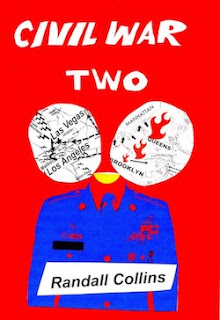
As I mentioned earlier, the cyber-war expert P.W. Singer’s novel, Ghost Fleet, envisions the US being devastated by a Chinese cyber attack that incapacitates the US military. In the novel, the US makes a come-back by resuscitating an old moth-balled World War II fleet, unhackable because its controls are pre-digital; plus creating some advanced weapons that can’t be diverted from their targets since they carry no on-board mini-computer to be taken over. I have written my own thought-experiment, a novel about a hypothetical civil war, in which the American military divides and fights itself with exactly the same weapons on both sides. (Just as happened in the Civil War of 1861-65). The novel is called Civil War Two. The war begins with cyber attacks attempting to turn bombers against their own bases. The solution to the cyber hacking is to shut down the computerized system and build another control system. High-tech aircraft have enormous capacities for locating enemy targets and firing back at their electronic location; but since both sides can do this, the result is to destroy a large proportion of the most advanced aircraft on both sides.

Moreover, the most advanced aircraft are the most expensive, and take the longest time to build, as well as requiring assiduous maintenance between missions-- e.g. a B-2 stealth bomber costs over $1 billion dollars each, plus operating costs. Attrition of such weapons would inevitably result in older weapons being pressed into service. Even a battle between robots would be, most likely, not Hollywood's humanoid giants on two legs, but armored tanks containing no humans, like driverless cars firing at each other. The outcome of such a battle would depend, not on the superiority of one side’s robots over the other, but on the skill and energy of humans going out onto the battlefield to repair the damaged robots. My chief conclusion is that a war fought between two very advanced militaries would lead over time to mutual degradation, and a return to earlier forms of warfare.  

I have already suggested that remote computerized communications and control would be shut down early in such a war. If both sides have drones, armored helicopters, anti-missile missiles, and robot vehicles, the mutual attrition would eventually result in humans making the difference. 

High-tech stalemate will drive combat back to the human level. The idea that has prevailed for about a century-- that the state would win which created the next super-weapon before the other side did-- will probably not hold in the future. That is because the recent wave of digital technologies, whose initial thrust has come heavily from military inventions, has spread into the civilian economy and ordinary life; and warfare centered in the cyber sphere gives most advantage to the disrupters of the other side’s communications. This is true whether it be asymmetrical terrorist attacks against a military and economic behemoth; or symmetrical war between states with equally sophisticated equipment.

Our idea that history is moving in a straight line is wrong. What seems unthinkable now-- shutting down the Internet and all the other digital media-- in one degree or another is likely to happen. Where we come out on the other side of that crisis will probably become normal to people who live in it, just as the digital devices of the last 15 years have become so normal that we can’t imagine living without them.  If we continue to live, it will probably be because we have learned to get along without them.

https://www.amazon.com/Civil-War-Two-Part-Determined-ebook/dp/B07B1TSNWH/ref=tmm_kin_swatch_0?_encoding=UTF8&qid=1523915690&sr=8-1&dpID=51yuwsdw%252BeL&preST=_SY445_QL70_&dpSrc=detail

P.W. Singer and August Cole.  Ghost Fleet. A Novel of the Next World War. Mariner Books. 2016.