Marilyn
Monroe had a famous career: famously good, famously bad, pretty much
simultaneously. Once launched, everything she did made her famous; and
everything she did caused her grief.
Why? Look
at it from the point of view of her networks.
[1] Hollywood film industry. She grew up on
the periphery of Hollywood, and from an early age her ambition was to be a
star. She went along with the casting-couch system, and as a result got looked
down upon as just a studio whore. But she kept coming back, from other
angles...
[2] Glamour photographers. This network
provided her early livelihood, and caused the first big scandal that propelled
her to the center of attention. Photographers were her comfort zone. They kept
her in the public eye (for better or worse, including the second scandal that
broke up her celebrity marriage). And photographers and their spouses were her
strongest friends, the fallback whenever everything else went bust.
[3] A celebrity among celebrities. She hung
around with big names like Frank Sinatra and Joe DiMaggio, her second (but
first famous) husband. The result was a home vs. career conflict, and even
worse, a spotlight contest that she was bound to win, and lose a husband.
[4] Theatre intellectuals. These became
allies in her battle versus Hollywood studio scorn, low pay, and stereotyped
roles. She got in tight with the New York elite of acting coaches and
directors, and married the most famous playwright of the day. But from now on,
her acting coaches would be in tension with whatever film directors she worked
with.
[5] The star/politician nexus. Already
during third husband-to-be Arthur Miller’s fight with the House Un-American
Activities Committee, Marilyn was becoming connected with the liberal
intellectuals. With the coming of Camelot, the media-beloved Kennedy White
House was glamorized by its overlap with the Hollywood “rat pack” of Sinatra,
Kennedy in-laws, and other party animals. Marilyn is linked sexually with JFK
and his brother Robert, until it becomes a little too openly scandalous and she
is dropped. Later, Joe DiMaggio would blame Sinatra and the rat pack for the
drugs and drinking that led to her death.
[6] Her psychiatrists. By this time, she is
dependent on psychiatrists, if not to sort things out, at least to give her
drugs and a semblance of allies. One of them betrays her—worried over suicide—by
having her locked up an mental hospital. Who gets her out? Her most heavyweight
lover, Joe D. Not long after, her alcohol-and-drugs diet kills her anyway.
Her
networks offset each other, providing a succession of reliefs, which turn into
new strains. [1] clashes with [2];
[1-2] clashes with [3]; [1-2-3] clashes with [4] and with [5]. [6] claims to deal with the clashes but just
extends the damage.
Her
networks canceled each other out—as support networks. But their overall effect
was to make her as big a star as could be: the center of maximal attention
whatever she did. Whatever you can say about Marilyn, there was no dead air.
What was
Marilyn really like?
In a way,
this is not a very sociological question. Erving Goffman said that everyone has
a frontstage self (or more than one), plus a backstage part of your life where
you put on your clothes, your make-up, and your way of dealing with the people
you’re going to meet. But he also denied that the backstage is the real self,
since it is shaped by what you do on the frontstage part; it isn’t any more
spontaneous or “real”, just an alternation between preparation, social performance,
and down-time. Marilyn had a complicated personality, which means her total
self was a sum of how she dealt with all her networks; and since her networks
were energizing her, pulling her this way and that, she was the sum of multiple
attractions and their strains.
There was,
however, a constant core to pretty much everything she did. She was always very
ambitious and determined. She was not a
weak person; that was a role she played, wispy-voiced, naive
little-girlish. She seemed passive and clue-less, but she always stole the
scene, whether on-screen or off.
From her
early childhood, she wanted to be a movie star. Her mother worked as a film
negative cutter at a company that processed films for all the studios. Her
mother gave her up to foster parents within a few months of her birth in 1926,
but visited the little girl from time to time and took her to the movies and to
see the sights of Hollywood. When Marilyn was 6, her mother bought a small
house in Hollywood, which she shared with her daughter and a family of actors.
This lasted less than a year, when the mother had another breakdown and was
committed to a mental hospital. Marilyn continued living with the actor
housemates, then her mother’s friend Grace took over, along with other friends
and relatives in the Los Angeles neighborhoods near Hollywood. (A fairly
accurate picture of this Hollywood-fringe lifestyle is in the first part of
Nathanael West’s 1939 novel, The Day of
the Locust.)
There was
virtually nothing else. Her mother, a flapper-type of the 1920s, had lovers,
and Marilyn was probably an illegitimate child.
Marilyn was effectively an orphan, shunted around from one foster parent
to another (then as now, foster parents often took in a number of children).
She lived in an orphanage from age 9 to 11; then with another foster family—in
all a total of 10 different families. She married, as soon as she could after
her 16th birthday, to avoid being sent back to the asylum when her foster
family moved out of state. Her choice of husband was just a convenience, a boy
who lived next door. Since this was 1942 and WWII had broken out, he shipped
out to the Pacific while Marilyn lived with his parents and worked in a defense
factory. There was no sentiment in the marriage; Marilyn said they had nothing
to say to each other and it was boring. When he came back in 1946, he objected
to Marilyn’s new-found career as a photographer’s model, so they divorced.
In 2010,
some notebooks of Marilyn were found among the effects of one of her acting
coaches. These contained two main themes: her ambition, self-reminders to work
hard and master the craft of acting; and feelings of being alone, always alone.
Since these notes were from the period after she was already a star, these were
life-long preoccupations-- if this is how she felt when her networks were dense
and active, how would she have felt when she was cast adrift, bouncing back and
forth between ephemeral families and institutions, bit parts and photo gigs?
Still, her ambition was her salvation; it was her energy-center, giving her a
purpose and a trajectory. One cannot say she was a person of low emotional
energy. Her ambition was the thread that kept her going.
What was
she like backstage? (in Goffman’s sense, not just in the movie world) Our best glimpse into that side of her life
is an account by Truman Capote of an afternoon he spent with her in April 1955.
They are at a funeral parlor in New York, a memorial for a grand old lady of
the theatre who had been something of a mentor to Marilyn. As usual, Marilyn is
very late. When she arrives in the entry hall, she explains she couldn’t decide
what to wear—was it proper to wear eyelashes and lipstick? She had to wash it
all off. What she decided to wear was a black scarf to hide her hair, a long
shapeless black gown, black stockings, combined with erotic high heels and
owlish sunglasses. She is gnawing at her fingernails, as she often did.
Marilyn:
“I’m so jumpy. Where’s the john? If I could just pop in there for a minute--”
Capote: “And pop a pill? No! Shhh. [...They’ve]
started the eulogy.”
They sit in
the last row through the speeches. After it’s over, Marilyn refuses to leave.
Marilyn: “I
don’t want to have to talk to anybody. I never know what to say.”
Capote:
“Then you sit here, and I’ll wait outside. I’ve got to have a cigarette.”
Marilyn:
“You can’t leave me alone! My God! Smoke here.”
Capote:
“Here? In the chapel?”
Marilyn:
“Why not? What do you want to smoke? A reefer?”
Capote:
“Very funny. Come on, let’s go.”
Marilyn: “Please. There’s a lot of shutterbugs
downstairs. And I certainly don’t want them taking my picture looking like
this.” ... “Actually, I could’ve worn
makeup. I see all these other people were wearing makeup.”
Capote: “I
am. Gobs.”
Marilyn:
“Seriously, though. It’s my hair. I need color. And I didn’t have time to get
any. It was so unexpected. Miss Collier dying and all. See?” She displays, under her scarf, a dark line at
her hair part.
Capote:
“Poor innocent me. And all this time I thought you were a bona-fide blonde.”
Marilyn: “I
am. But nobody’s that natural. And incidentally, fuck you.”
They sit
and talk. Marilyn goes on to say that Miss Collier’s companion is going to live
with Katherine Hepburn. “Lucky Phyllis... I’d change places with her pronto.
Miss Hepburn is a terrific lady, no shit. I wish she was my friend. So I could
call her up sometimes and... well, I don’t know, just call her up.”
The
conversation goes on. Marilyn: “Did I ever tell you about the time I saw Errol
Flynn whip out his prick and play the piano with it? Oh well, it was a hundred
years ago, I’d just got into modeling, and I went to this half-ass party, and
Errol Flynn, so pleased with himself, he was there and he took out his prick
and played the piano with it. Thumped the keys. He played You are My Sunshine. Christ! Everybody says Milton Berle has the
biggest schlong in Hollywood. But who cares? Look, don’t you have any money?”
Capote:
“Maybe about fifty bucks.”
Marilyn:
“Well, that ought to buy us some bubbly.”
They go to
a crummy bar on Second Avenue. Marilyn: “This is fun. Kind of like being on
location-- if you like location, which I certainly don’t. Niagara. That stinker. Yuk.”
Capote: “So
let’s hear about your secret lover.”
Marilyn
giggles while Capote keeps silent.
Marilyn:
“You know so many women. Who’s the most attractive woman you know?
Capote: “No
contest. Barbara Paley. Hands down.” (wife of the owner of CBS television
network)
Marilyn
frowns: “Is that the one they call ‘Babe’? She sure doesn’t look like any babe
to me. I’ve seen her in Vogue and
all. She’s so elegant. Lovely. Just looking at her pictures makes me feel like
pig-slop.”
Capote:
“She might be amused to hear that. She’s very jealous of you.”
Marilyn:
“Jealous of me? There you go again,
laughing.”
Capote
explains that a gossip columnist wrote about a rumor that Marilyn was having an
affair with William S. Paley, and his wife believes it.
They trade
sex stories. Capote tells of a homosexual fling he had with Errol Flynn.
Marilyn: “It’s not as if you told me anything new. I’ve always known Errol
zigzagged. I have a masseur, he’s practically my sister, and he was Tyrone
Power’s masseur, and he told me all about the things Errol and Ty Power were
doing.... So let’s hear your best experience. Along those lines.”
Capote:
“The best? The most memorable? Suppose you answer the question first.”
Marilyn:
“And I drive hard bargains! Ha! (Swallowing
champagne) Joe’s not bad. He can hit
home runs. If that’s all it takes, we’d still be married. I still love him, though.
He’s genuine.”
Capote:
“Husbands don’t count. Not in this game.”
Marilyn
(nibbling her nail, really thinking): “Well, I met a man, he’s related to Gary
Cooper somehow. A stockbroker, and nothing much to look at-- sixty-five, and he
wears those very thick glasses. Thick as jellyfish. I can’t say what it was,
but--”
Capote: “You can stop right there. I’ve heard all
about him from other girls... He’s Rocky Cooper’s stepfather. He’s supposed to
be sensational.”
Marilyn:
“He is. Okay, smart-ass. Your turn.”
[Capote
continues his memoir:] “While I paid the check, she left for the powder room,
and I wished I had a book to read: her visits to powder rooms sometimes lasted
as long as an elephant’s pregnancy. Idly, as the time ticked by, I wondered if
she was popping uppers or downers. Downers, no doubt... After twenty minutes
passed, I decided to investigate. Maybe she’s popped a lethal dose, or even cut
her wrists. I found the ladies’ room, and knocked on the door. She said, ‘Come
in.’ Inside, she was confronting a dimly-lit mirror. I said, ‘What are you
doing?’ She said, ‘Looking at Her.’ In
fact, she was coloring her lips with ruby lipstick. Also, she had removed her
somber head-scarf and combed out her glossy fine-as-cotton-candy hair.”
Marilyn is
in a good mood now. She wants to take a taxi to the Staten Island ferry and
feed the seagulls. [Capote 1975.]
Truman
Capote was part of the celebrities network. He made a big splash by 1948 in the
New York literary scene as novelist, enfant
terrible of boyish good looks and flaunting homosexuality long before it
was fashionable. He made literature out of whatever he observed, and specialized
in backstage gossip about other celebrities, as well as hangers-on wannabes and
small-town transients like himself. His conversation with Marilyn is a good
specimen of the way he talked. As we can see, they are comfortable together.
 |
| Marilyn and Truman Capote dancing, April 1955—the same month of this conversation. |
The
celebrity world is usually depicted as a superficial place, where prestige
attracts prestige, famous people basking in each other’s limelight and thus
multiplying their prestige by being seen together. This is true, but it misses
another dimension: celebrities—if they have friends—usually make friends with
other celebrities, because they share the same viewpoint on the rest of their
lives. They have the same problem of being instantly recognizable, so that they
cannot have an ordinary conversation with most people. (The Beatles used to
refer to their encounters with fans as being “Beatle-ized” when people gush
with amazement at seeing them.) Sociologically, what makes for spontaneous
friendships is the feeling of sharing the same backstage, us in a private
enclave against the world.
Marilyn,
even at the height of her fame in 1955, still has a certain amount of that
star-struck attitude about others. She wishes she could be friends with
Katherine Hepburn, and feels inferior to the elegant Barbara Paley—a common
denominator here is that these are both women of the hereditary upper class,
while Marilyn made her way up from the working class. Privately, Marilyn is
crude, cynical, and on the whole disgusted with Hollywood, although she also
revels in the insider knowledge she has about everyone’s sex lives (not least
from her own experience). She would like to get out, but it is her career
mainstay; and she senses there is part of the New York world that will never
accept her, even if her intellectual pals are willing to patronize her as long
as she stays eager and humble.
Three years
later, Capote published his most famous novel, Breakfast at Tiffany’s. In 1960, he tried to get her cast in the
female lead for the film version, but the studios considered Marilyn too much
trouble, and Audrey Hepburn got the part. The central character is a “treats
girl”—a sexy young woman who lets herself be picked up in expensive bars by men
on expense accounts, and lives on asking them for $20 bills to “tip the maid in
the powder room”—and usually cutting out to avoid further sexual obligations. Holly Golightly
could have been modeled on Marilyn, a ditsy but good-hearted waif, who has a
deserted husband from a small town, acts as a go-between for a Mafia boss in
prison, and befriends a preppy young writer living in her apartment house who
resembles a younger Truman Capote. You have to wonder how Marilyn would have
liked playing this role, and if her friendship with Capote could have survived.
Her marriage with Arthur Miller would break up when she started acting the
script of The Misfits that Miller wrote for her--depicting a flighty,
screwed-up personality based on herself. So this is what you think of me?
[1. Part 1]
Hollywood Studios
Hollywood
is first of all the meat market, where a crowd of aspiring young actors vie for
the attention of a small number of studio chiefs and whoever else can help them
get their break. Since the 1920s it was also the sex scene, known for risqué
parties and goings-on (Rudolph Valentino, Louise Brooks, Errol Flynn), slightly
veiled behind a publicity apparatus that made everthing look like peaches and
cream. Marilyn had no inhibitions about playing it for what it was. She had
affairs with studio executives and talent agents, including the agent who
arranged her first part in an important film, The Asphalt Jungle (shot in 1949, when she was 23 years old) and
got her a seven-year contract with 20th Century Fox late in 1950. But Marilyn
had been in and out of the studios ever since she was 20, where she was mostly
regarded as too light-weight to be an actress, and too eager to make it
necessary to do much to get her cooperation. She was willing to serve as
eye-candy at Hollywood parties as long as she was invited, and often this meant
going upstairs with whoever was an important guest. Combined with the passive
naive-beauty roles she was given, Marilyn came to be looked down upon as the
studio whore, an attitude that would dog her throughout much of her career.
Marilyn built an extensive network inside Hollywood, but for the first
half-dozen years it was a network circulating the wrong kind of reputation.
She got a
couple of short-term contracts in 1946-7 and again in 1948 (age 20-22),
resulting in a few bit parts in minor films. She was eager to work and threw
herself into gym workouts, dance lessons, and acting lessons. She even paid to
continue lessons after her contract ran out--which also kept her on set and in
the networks. (Her reputation of being hard to work with on the set would come
later, as she became successful.) Though she was in and out, contract-wise, she
gradually built up a few film credits, showing that she could wear beautiful
costumes, stand out in a chorus line, sing and dance. Groucho Marx got her a
part in a comedy; Carey Grant played opposite her in Monkey Business, a farce about a middle-aged lawyer who takes a
drug that turns him into a teen-ager. Her comedy roles were always the dumb
blonde, varied by film noir roles as a gangster moll and mentally ill
characters like a freaked-out baby sitter in Don’t Bother to Knock and the lead in Niagara (both released 1952).
On the whole, Hollywood was an ordeal from her late teens until age 26,
and most of what success (and livelihood) she got was not from films but from
photography.
[2] Glamour photography
Marilyn got
her start while working a defense factory, when she was approached by a
military photographer looking for “Rosie the Riveter” type inspirational
pictures. It was her entry to a network that included not only photographers,
but modeling agencies and their customers: magazines, advertisements, calendars,
pin-ups, and studio publicity. In early 1945, Marilyn was able to quit her
factory job and by the next year, had appeared on the cover of over 30
magazines, not yet the big ones but respectable ones like Pageant and Family Circle, as well as U.S. Camera and sex-tease mags. (The San Fernando Valley, across
the Hollywood hills, was then as later a national center for pornography, but
Marilyn stayed on the respectable side of the line-- which paid better, in any
case, since conventional magazines had bigger circulation.) Her reputation for bathing-suit shots spread,
and she was picked up as an artist’s model for well-known pin-up artists Earl
Moran and Earl MacPherson. It was during one of her hard times, laid off from the
studios and needing money, in 1949, when she posed for the nude photos that
would later make her famous.
It was an
unusual photo angle, shot from the top of a ladder looking down on her lying on
a bright red curtain, and became the best-selling calendar photo of its time.
Color photography was just emerging as a viable printing process, most
photographs previously having been black-and-white. Marilyn would repeatedly
feature in the technological breakthroughs in all the visual media. The nude
photos came back to haunt her in March 1952, when gossip columnists spread the
story that she had posed in the nude 3 years before. But 1952 was Marilyn’s break-out
year. The previous fall she was on the cover of Collier’s (one of the big national photo-news magazines), and soon
after made the covers of Look and Life.
Niagara was about to be shot
and would be on screens next year with Marilyn as top billing. The studio
executives worried about the nude calendar but Marilyn handled the rush of
reporters with aplomb: “It’s no big deal. You can get a copy of it anywhere.”
And asked if she had nothing on during the photo, she replied in her
little-girl voice, “I had the radio on.” Set up for scandal, she stole the
scene. That’s one definition of emotional domination of the situation, however
meek and passive her demeanor.
Marilyn had
become too big in the photo world for the studio bosses to cut her out any
more.
It was her
photo career that made her transition to the iconic Marilyn Monroe. Norma Jean
Mortenson, as a young photo model, was a brunette with curly hair. She changed
her name to Marilyn Monroe during a screen test. Meanwhile her photos show her
curls straightening out to wavy, her brown hair shading into red, then
reddish-blonde (red-heads were considered hot stuff in the 1940s), and by 1950
to now-classic platinum blonde. Her agent had her hairline raised (to eliminate
the widow’s peak seen in her early looks), and according to rumours, possibly
also paid for a minor nose-job. Her photos show the addition of a small
beauty-mark on her left cheek from 1950 onwards. This was the look of the 1953
photo that Andy Warhol would use for his multi-colored Marilyn silkscreen in
1962, just after she died, sealing her icon status in another medium. Marilyn created her own image, but the
photographers, agents, and artists had a hand in it too.
 |
| Marilyn's hair: 1946, 1947, 1950 |
[1. Part 2]
Hollywood
Two big
technical developments were happening in the film business just as Marilyn
became a star. One was Technicolor. Color films had occasionally been made
since the late 1930s—The Wizard of Oz
was one, starting out black-and-white in Kansas and then switching to color for
the Land of Oz—but until the early 1950s most films were black-and-white.
Technicolor as it appeared in the late 1940s was garish, bright but
unnatural-looking. Natural-looking color
was achieved in the 50s, and Niagara
publicity trumpeted it as the combination of two of the world’s great
spectacles, Niagara Falls and Marilyn Monroe. The scenic aspect of outdoor
films, which was never very good in black-and-white, was now a big selling
point for the movies. They needed it, because these were the years television
had taken off; movie attendance had peaked in 1946 and now had declined over 60
per cent. But TV was black-and-white and didn’t get very good color until the
late 1960s, so Hollywood exploited color films as hard as it could. *
*
Black-and-white continued to be used until the end of the 50s for serious
films. On the Waterfront-- Elia Kazan’s
1954 drama of labor corruption, with Marlon Brando’s famous “I coulda been a
contender” scene, was turned down by 20th Century Fox because Kazan didn’t want
it made in color.
The other
gimmick that Hollywood had over TV was big, wide-screen spectacles. There were
initial technical problems. The early version was called Cinerama; it required
special theatres with a triple-wide screen, each with a separate film
projector. This was too cumbersome and expensive, but by 1953 it was replaced
by Cinemascope, which required only one projector and one film instead of
three. The first big Cinamascope block-buster appeared in 1953, a Biblical
epic, The Robe, starring Charleton
Heston with his famous chariot race. The second was Marilyn Monroe’s film, How to Marry a Millionaire, also in
1953. It wasn’t a great film and had a silly plot, but it was packed with stars—Marilyn
along with her two predecessors, Lauren Bacall and Betty Grable—a it paid back
its huge production costs many times over within its first month. A much
wittier film was Marilyn’s earlier film of the same year, Gentlemen Prefer Blondes, co-starring Jane Russell, whom she also
up-staged; it also made a lot of money. So 20th Century Fox immediately piled
into producing yet another big Cinemascope film, River of No Return, a frontier action-adventure pairing Monroe with
Robert Mitchum. She later called it “a grade-Z cowboy movie in which the acting
finished second to the scenery and the Cinemascope process.” The appeal of Cinemascope soon wore out, and
20th Century Fox almost bankrupted itself over the next 10 years, especially
with the over-long four hour production Cleopatra
(finally released in 1963) starring Elizabeth Taylor. During these years of
trouble, Marilyn Monroe films were the chief money-makers for the studio.
 |
| Marilyn with studio bigwigs (1953) |
By 1955,
Marilyn was bigger than everybody and ready to rebel. She was still getting the
modest salary negotiated in her 1950 contract; she wanted commensurate pay and
better roles than the dumb blonde stereotype. The studio, still
under-estimating her, refused. She walked out. This was news. Hollywood
contractual disputes were usually behind closed doors. How could someone with
such a weak personality do this sort of thing?
[3] The Celebrity Network
In 1956,
sociologist C. Wright Mills published The
Power Elite, a portrait of the upper
reaches of stratification in the United States. His main argument was that the
country had morphed into a pyramid ruled by three overlapping groups: the
executives of the big corporations; the top officers who shuttled between the
interchangeable branches of the military-industrial complex; and the cabinet
officials who served no matter which party held the presidency, and who came
from the same Ivy League schools and the same Wall Street firms. (Sounds
familiar?) He also pointed out that the old fashioned Upper Class, the
hereditary rich families of the Social Register in New York, Boston, and
Philadelphia still existed (one of their daughters married John F. Kennedy),
but that they no longer really counted as sources of national power, or even of
prestige. They were no longer in the public eye the way they had been when the
Titanic sank (when the headlines listed which members of “Society” were on the
ship). What had displaced them was a group called Celebrities.
Celebrities
were anyone who was famous, which meant anyone who had their picture taken a
lot, and were in the news just by being visible. Celebrities could be athletes,
singers, movie stars, famous writers (Hemingway; Tennessee Williams), band
leaders, people who broke flying records (Charles Lindbergh, Howard Hughes,
Amelia Earhart). What created Celebrities, as a group phenomenon, was the rise
of the mass media. Above all, these were the newspapers and magazines, which
underwent an era of tremendous popularity (and profitability) from the 1920s
through the 50s. Photos were a big part of this; it was only around 1920 that
cameras became portable so that photographers (later called paparazzi) could
swarm all over places where celebrities might be seen; and when newsprint
publications could afford to sprinkle their pages with photos. Celebrities were
wanted because of an unsatiable need for things to fill papers with; celebrity stories had legs, whether there was
any breaking news or not. In the 1930s, glossy black-and-white photos in
magazines became economically feasible. Hence the world of celebrities.
Hollywood was a favorite photo/ news/ gossip site. A broader swathe of famous
persons could be found in the restaurants and night clubs of New York, where
almost anyone who was anyone could be seen and gossip columnists could write
about who they were seen with.
Marilyn may
not have been very aware of the world of Celebrities when she was young and
completely Hollywood-struck. But she soon found out; in fact, she became a
celebrity before she became a star. By around 1950, she wasn’t just trading sex
for entrée into Hollywood parties; she was having affairs with the stars,
including Marlon Brando, Yul Brynner, and big-name director Elia Kazan. In her
breakout year, 1953, she became connected with the biggest name of all—Joe
DiMaggio. Just recently retired from the New York Yankees, DiMaggio was the
biggest star on the most famous team in the most popular American sport. (His
teams had gone to the World Series 10 out of 13 years; fans and sports-writers
used to debate about who was the greatest of all time, DiMaggio or his
predecessor, Babe Ruth.) In January 1954, Marilyn and Joe were married.
They
honeymooned in Japan. Marilyn took time out to go to Korea, where the Korean
War had ground to a stalemate, to entertain tens of thousands of American
troops. Singing outdoors in a spaghetti-strap gown in the February cold, she was
received with wild enthusiasm. “You never heard such cheers!” she told
DiMaggio, upon returning. “Yes I have,” he said. He had; but that was then, and
this was now. Their marriage immediately started coming apart.
Further
strains appeared. DiMaggio was from an old-fashioned Italian family. He didn’t
want his wife to work (it was a mark of not being able to support your own
family); he wanted her to stay home and cook for him and his buddies. She
tried, a bit, but she had a career and movies to make. In September 1954, they
are in New York City. Marilyn is shooting The
Seven Year Itch. Director Billy Wilder has concocted a scene where she
stands over a subway grate while the air from the train rushes up and blows her
skirts above her waist. It is a hot summer night, and Marilyn is enjoying it—the
rush of air, showing off her great legs, the several thousand men and dozens of
photographers gathered to watch. It goes on for several hours. Joe DiMaggio is
there watching, with the wife of Marilyn’s personal photographer and manager,
Milton Greene. Joe is getting angrier and angrier, every time her dress blows
up to reveal her panties, and the crowd cheers.
He walks off in disgust. Next month they are divorced.
 |
| Marilyn with director Billy Wilder, planning the skirt-blowing scene (Sept. 1954) |
Clash of
life-styles? Yes. But also, Marilyn has
upstaged him completely. And she always would.
[4] Theatre Intellectuals
The theatre
world—which mostly meant New York City—had always overlapped with Hollywood. In
the 1910s, before Hollywood, films were mostly made in or around New York, and
Broadway producers were at the fore among those who created Hollywood in the
1920s. Burlesque stars like Mae West and
dancers like Fred Astaire moved on to films; famous plays were often made into
movies; and stars of the “legitimate theatre” continued to circulate between
the stage and the movies up through the 1950s and even later. But already in
the 20s, there were film stars who never did theatre; and these became more
prominent over time. They were two different kinds of media, and the difference
expanded as films became more outdoors, more action-oriented, and more colorful
and spectacular.
In moving
from Hollywood to the New York theatre world, Marilyn was moving in a
conservative direction. It was also a claim for prestige. The theatre world
tended to look down on films as a second-rate medium; and intellectuals in
general regarded films as low-brow entertainment. True, famous writers like
Scott Fitzgerald and William Faulkner spent time as Hollywood script writers,
but this was just a way of raising their incomes. Some Hollywood studio chiefs—notably
Darryl Zanuck, the head of 20th Century Fox, and Marilyn Monroe’s chief
detractor—tried to raise the status of films by making “serious” movies; but
they largely had to give this up in the 1950s when competition from TV moved
them in the direction of colorful spectaculars. One can see the pattern in the
fact that there were no film schools and no “film critics” until James Agee in
the 1940s and 50s started trying to review films in the same spirit as
reviewing plays. There was little sense of what was a film “classic” until the
1960s and later. *
* Though
looking for outstanding developments in the film art, Agee completely missed the significance of
film noir, the main innovation of his own day; he thought that films ought to play an important part in the social developments of modern times, such as making patriotic
movies about World War II. Not surprisingly, his film reviews were mostly
negative.
Marilyn
already had network ties with the theatre intellectuals from the early 50s.
(After all, there was Brando, Elia Kazan; and she’d acted alongside Bettie
Davis in All About Eve, which is
precisely about an aging theatre queen and her ambitious understudy.) After divorcing Joe DiMaggio and breaking her
Hollywood contract, in 1955 she moved to New York, where she was taken in by a
famous art-photographer Milton Greene and his wife. Greene did a series of
sensitive photos of Marilyn (not as film star or sex kitten but moody,
swan-like, etc.). He also floated the idea of forming an independent company,
Marilyn Monroe Productions, with themselves as partners.
Meanwhile
Marilyn starts over again, “from the bottom” (sort of), by joining other
would-be actors at the Actors Studio run by Lee Strasberg. He is a proponent of
method acting, getting into your own emotions, feeling yourself in the role.
Marilyn is met with skepticism by the other actors but Strasberg and his wife
Paula find Marilyn has potential. For the rest of her career, Paula would be
Marilyn’s personal acting coach, at her side on the set of every movie she
made.
In January
1956, 20th Century Fox caved in. She got a new contract, with options to choose
her own films and directors. Marilyn Monroe Productions also had the right to
make one independent film a year. She and Milton Greene made this a priority.
Their first film would be in England, directed by (and co-starring) Sir
Laurence Olivier. Olivier was probably the most prestigious theatre/film
cross-over in the world, famed for his Shakespeare and for films of classic
novels like Wuthering Heights. The
film had a not-so-promising title, The
Prince and the Showgirl; but in fact it was a first-rate comedy by the
playright Terence Rattigan, the foremost follower of the style of George
Bernard Shaw, with its witty dialogue and surprising plot reversals. This should be
the perfect launch to Marilyn’s new phase as a serious actress.
What could
go wrong? For one thing, something that at the time seemed very much to be
going right. Marilyn falls in love with Arthur Miller. He was at the top of the
theatre world; his 1949 play, Death of a
Salesman, would be for decades the most widely performed play ever written
by an American playwright. It does nothing to hurt his public image that he is
in a fight with HUAC over their effort to compel him to testify against former
Communist party members and sympatheizers from the 1930s. This is a fight that
had convulsed Hollywood, too, although Hollywood came down on the side of
Communist-busting and a number of writers had been blacklisted. Marilyn had
never been involved in politics, but now that her fiancée was called before the
Committee (and its cameras) in Washington, she is right there beside him. When
the politicians threaten to prevent him from traveling to England for the
Olivier film, Marilyn’s admirers exert pressure on the other side, and he gets
the passport. Marilyn and Arthur are photographed at their wedding at his home
in rural Connecticut, where she is blissfully happy, just to be married to such
a wonderful man.
In England,
Marilyn and Arthur were greeted and photographed with Laurence Olivier and his
wife, Vivien Leigh (who played Scarlet O'Hara in Gone with the Wind), but cordiality soon ended. Now accustomed to
method-style directors, Marilyn asks Olivier how he wants her to play her part.
“Just be sexy,” he tells her. She is insulted and upset. They fight throughout
the filming, Arthur putting in advice and Paula Strasberg conferring with
Marilyn before every shot. The Prince and
the Showgirl is a financial flop and leaves a bad taste in everyone’s mouth.
(In fact it is very viewable today, even though it doesn’t feel quite like the
same Marilyn Monroe).
It is the
beginning of a series of bad relationships with directors. She is consistently
late on the set. She cancels and calls in sick. She forgets her lines, or
botches them repeatedly. She argues with directors and retreats into
conferences with Paula. During the shooting of Some Like It Hot in 1958, her co-star Tony Curtis famously said
that “Kissing Marilyn Monroe is like kissing Hitler”—in exasperation at the
endless re-takes. And this was to be the only really successful box-office hit
that she made after re-inventing herself as a serious theatrical actor.
Marilyn had
won the right to choose her own directors, but it doesn’t improve matters. She
argued with top directors, Broadway and
Hollywood legends alike. Her first effort at a serious drama, Bus Stop (1957), is a contemporary or
real-life version of a cowboy movie where Marilyn is a cafe singer kidnapped by
an enamoured rodeo cowboy. She played opposite 59-year-old Clark Gable in The Misfits, another real-life Western about aging cowboys
trying to make some money rounding up wild horses. Arthur Miller had written
the script especially for her, but his habit as a professional writer was to
turn real people into material for drama, and it shocked her as a portrait of
herself. Whether cast realistically or in film fantasies, she always ended up
being the dumb and/or neurotic blonde beauty. Arthur left the set and she began
another affair. Shooting dragged out, her films always behind-schedule and
over-budget.
We can see
the deterioration in photos of Marilyn in this period. Earlier, there had been candid photos of her
biting her nails with tension, but now her face looks bland and washed-out.
She carried a flask of gin on the set and drank between takes, a dangerous
combination with the pills she took to wake up in the morning and the sleeping
pills she took at night.
 |
| Marilyn biting her nails (1952) |
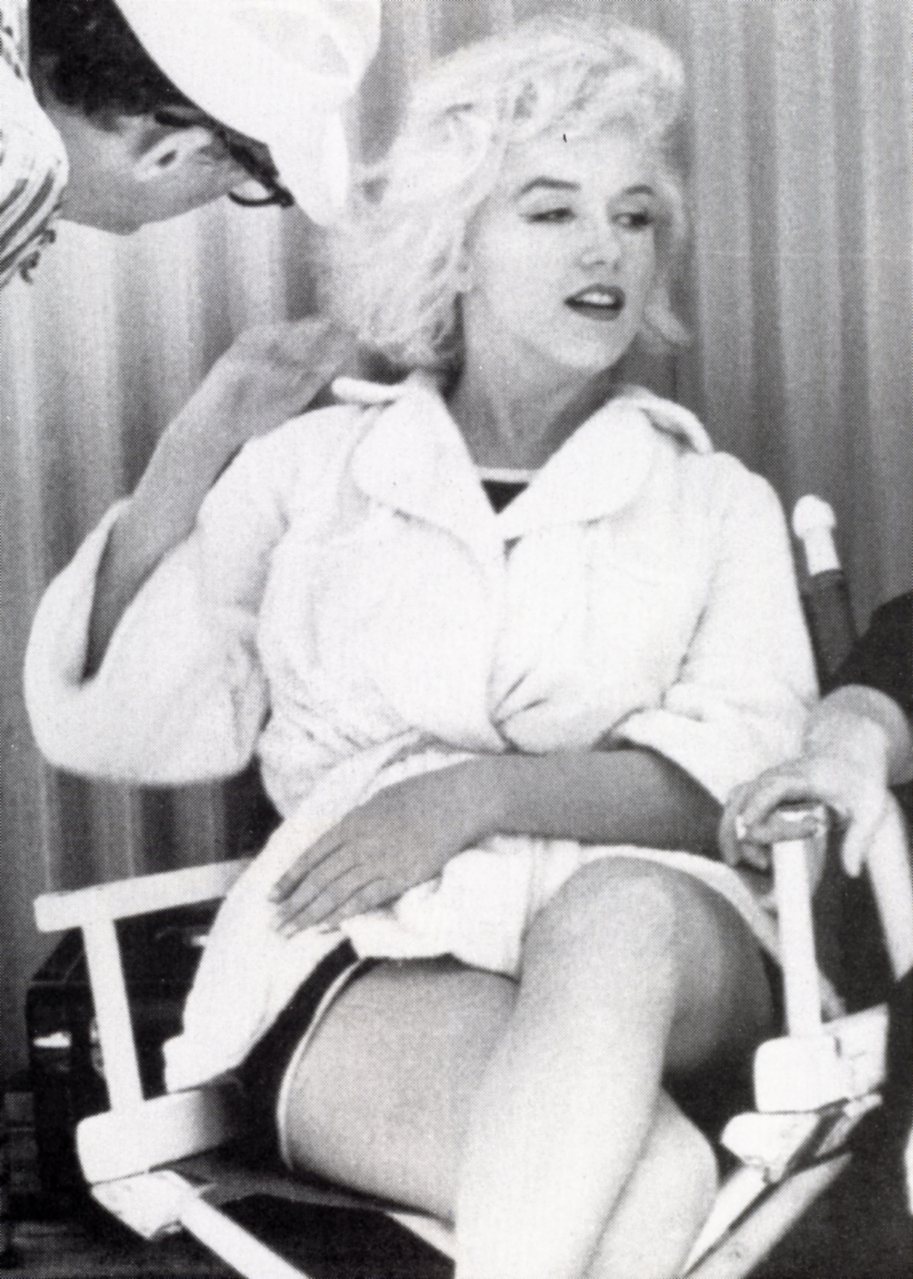 |
| Between takes of Some Like It Hot (1958) |
 |
| Arguing with George Cukor, famous comedy director, on the set of Let’s Make Love (1960) |
[5] Camelot
In November
1960, John F. Kennedy was elected President, promising to bring a youthful new
approach to the White House. He brought youthful good looks, an even younger
and beautiful wife, and created enthusiasm that made him the most popular
President of the 20th century (with favorability ratings consistently around
70%). The Kennedy family were no strangers to Hollywood. The patriarch, Joseph
P. Kennedy, had bought and reorganized studios in the 1920s, ruthlessly taking
over a movie theatre chain, and carrying on a long affair with film star Gloria
Swanson while financing her films. (Yes, the one who played the aging star in Sunset Boulevard, 1950.) JFK reportedly had numerous affairs, both
before and after his marriage to Jacqueline Bouvier in 1953, including several
film stars before taking up with Marilyn, which began attracting attention from
his political enemies in early 1962. But
reporters in those days gave popular politicians space for their private lives
(they avoided photographing FDR in his wheel chair, and kept quiet about
General Eisenhower’s affair with his driver). Kennedy got along well with the
press, who showed the glitz of the Kennedy White House but not its backstage.
Marilyn had
already had an affair with Peter Lawford, a Hollywood actor married to JFK's younger sister. Now she was socializing with the rat pack, as we see in a photo with other stars at a
Las Vegas event—a fake look of enthusiasm on her mouth clashing with the
sadness in the rest of her face.
 |
| Marilyn with Elizabeth Taylor and Dean Martin, Las Vegas (June 1961) |
In June
1962, in the midst of yet another contentious on-again-off-again film project
for 20th Century Fox, Marilyn takes off
to fly to New York for JFK’s birthday celebration at Madison Square
Garden. It is her last famous photo scandal. Having kept the crowd waiting for
almost an hour, she appears in a clinging, flesh-colored gown and sings “Happy
Birthday to You, Mr. President” in her wispy voice. Kennedy, sitting in the
front row of the huge audience, makes no gesture of response. Immediately
afterward, his brother Bobby tells him the affair is getting too public and
warns him to break it off. He does, that very night. Marilyn is shut out. She can’t
even get through to Bobby by phone any more.
Back in
Hollywood, she is suspended by the studio.
A month later, she is reinstated with a new contract and a higher
salary, and called back to resume filming. Three days later she is dead: an
overdose of barbiturates, combined with whatever other drugs she was doing
during the day.
[6] Marilyn’s psychiatrists
Marilyn had
been seeing psychiatrists ever since her sojourn in New York in 1955.
Psychoanalysis was very much in vogue during the 1940s and 50s, and her coaches
at the Actors Studio encouraged her to explore her emotional depths. She had at
least four psychiatrists. The second of them, in 1957, was Anna Freud, the
daughter of Sigmund Freud. Such psychoanalysis was not expected to cure
anything, but was just part of a life-long process of knowing oneself. At any
rate, there was no indication psychiatry did Marilyn any good; her problems got
worse during the years of treatment.
Her
psychiatrist from 1957 to 1961 was Marianne Kris. These were the years of her
fights with directors, her breakdowns on the set, her estrangement and divorce
from Arthur Miller, her heavy drug use and drinking. The drugs were abetted by
her doctors, including the psychiatrists themselves; like celebrity doctors
then and since, they were impressed with having famous patients, and multiple
doctors would add up to unlimited prescriptions. By 1960, Marilyn had two
psychiatrists, Dr. Kris in New York, and Dr. Ralph Greenson in Los Angeles. In
March 1962, Dr. Kris decided that Marilyn was on the verge of suicide, and had
her admitted to a psychiatric hospital in New York. Marilyn went along with it
at first, until she found herself locked in a padded cell, under constant
surveillance, and cut off from communication with the outside. She began to
resist, to no avail. She refused to take part in therapeutic activities with
the other patients (supervised handicrafts and the like), declaring: “when I
start becoming one of them, I’ll know I really am crazy.”
At almost
exactly the same time, Erving Goffman published Asylums:
Essays on the Social Situation of Mental Patients and Other Inmates (1961).
In the late 1950s, Goffman had gotten himself into the schizophrenic ward of
mental hospital, incognito, for two years to observe what it was like to be
locked up, whether you were crazy or not. He concluded that the structure of
the mental hospital itself was making people worse, not better. It was a “total
institution,” where ones entire life was
under surveillance by staff who held all power over you--guards in a prison,
sergeants in a boot camp, orderlies and psychiatrists in an asylum. Inmates
were a degraded status, with no way to escape from their social position,
except by giving in to the staff’s definition of oneself as a spoiled self. You
had to give up your self in order for them to make you better (or at least
declare you were better so you could get out). Goffman argued that the bizarre
things that patients did in the mental hospital (like pissing on floor or
refusing to keep one’s clothes on) were a last gasp of autonomy, trying to show
they still had at least this much of a personal self by rebelling in trivial
ways. Goffman called this “the underlife of a total institution,” one version
of which is the “convict code” in prison.* This was the pressure that Marilyn
faced.
* Within a
few years after Goffman published this book, mental hospitals began to be
closed down.
Marilyn was
finally able to smuggle a message out to Joe DiMaggio. Why Joe? He still loved
her, she knew. And Joe D was a big name in New York, an old-fashioned hero type
who wasn’t going to let a bunch of bureaucrats stop him. Surrounded by an army
of reporters and photographers, Joe got Marilyn out.
Photos tell
the unspoken story. She and Joe are seen together for a while.
Uncharacteristically, Marilyn covers her face from the cameras. Joe looks
stony-faced. She sits beside him on the beach with a wan expression. He rescued
her, but he couldn’t save her.
 |
| Marilyn with Joe DiMaggio (1962) |
The old
networks were still there, still pulling her apart, and the networks were now
inside her. Her new psychiatrist, Ralph
Greenson, violates professional norms by trying to befriend his patient; he and
his wife invite her into their home. Marilyn moves into an apartment a few
minutes away. But she is back to the drugs and the drinking, the daily uppers
and downers; the back-and-forth with the studio; the collapse of her dream to
be something more than a Hollywood star. No one can befriend her in her
personal backstage, suspended between all the frontstages. She dies alone.
Did Marilyn
Monroe Have Charisma?
Let's see how she fits the check-list of different kinds of charisma.
Frontstage
charisma.
Obviously, Marilyn was not the kind of person who makes speeches and leads
crowds by swaying their emotions and beliefs. But no one was better at capturing
the center of public attention. In this
respect she was like Cleopatra, the master of spectacles, who left Mark Antony
sitting alone on his podium while the crowd flocked to see her. This makes us
broaden our theory of how charisma operates. It doesn’t have to be peremptory,
I’m telling you this! It is all the more effective when it is irresistible. In
public, almost everyone liked Marilyn, were charmed by her, men and women
alike. In part, precisely because she was not an authority; she never told
people what to do. Even as a sexual figure, she was never the femme fatale, the
malicious vamp, the money-grabbing whore.
She was most natural in front of a crowd: if you like to look at me,
I’ll blow you a kiss.
 |
| Marilyn with her public (1954) |
Backstage
charisma. This is
the realm of face-to-face relationships; the capacity for emotional domination
that is so striking in the way Jesus talked with people, always seizing control
of the conversation with an unexpected shift. Marilyn was not at all like this.
But when people pressed her (like reporters), she usually came up with a
stopper, a tag line that gave everyone pause, or made people laugh.
Success-reputation
charisma. The classic
definition of charisma is the general or politician who always wins: Alexander
the Great, Julius Caesar, Napoleon. This was not Marilyn. But-- if her aim for
success was to be a star, to be the center of attention, she never failed.
(After her career launch, of course; this launch-point is a key feature of any
“charismatic” life.) Unlike some (perhaps most) charismatic success-leaders, she
never lost her position, never became once-charismatic. Perhaps because she
killed herself at the right time; she did not hang on too long. Even her death
was big news; her legend was just beginning.
Fame as
pseudo-charisma. Just continuing to be a famous
name, with the passage of time, can get one the retrospective label of being
charismatic. I have argued this is a mistake, a confusing use of the term.
Queen Elizabeth, of Elizabethan fame, is an example of a person who was not
charismatic on any of the three main dimensions. But historic fame can
accompany real charisma. So far—60 years after her death—Marilyn Monroe checks
that box too.
Of course,
over the flow of history, 60 years is not a long time. Can we theorize what
makes some names resonant over the centuries? Yes... but that is another book.

References
James Agee.
2005 [originally 1941-50]. Film Writing and Selected Journalism.
Library of America.
Lois
Banner. 2012. Marilyn: The Passion and
the Paradox. Bloomsburg Books.
Truman
Capote. 1975. Music for Chameleons. Random
House.
Randall
Collins. Nov. 1, 2016. "Does Charisma Win Presidential Elections?" http://sociological-eye.blogspot.com/2016/11/does-charisma-win-presidential-elections.html
Bernard
Comment (ed.) 2010. Marilyn Monroe, Fragments: Poems, Intimate Notes, Letters. Farrar,
Straus and Giroux.
Robert
Dallek. 2003. An Unfinished Life: John F.
Kennedy, 1917-1963. Boston: Little, Brown.
Erving
Goffman. 1961. Asylums: Essays on the
Social Situation of Mental Patients and Other Inmates. Doubleday.
Erving
Goffman. 1959. The Presentation of Self
in Everyday Life. Doubleday.
James
Haspiel. 1995. Young Marilyn. Becoming
the Legend. Hyperion Books.
James
Kotsilibas-Davis. 1994. Milton’s Marilyn.
The Photographs of Milton H. Greene. Munich: Schirmer/Mosel.
Life
Magazine. 2009. Remembering
Marilyn. Time-Life Books.
C. Wright
Mills. 1956. The Power Elite. Oxford
Univ. Press.
Carl
Rollyson. 2014. Marilyn Monroe Day by
Day: A Timeline of People, Places, and Events. Rowman and Littlefield.
Robert
Sklar. 1993. Film: An International
History of the Medium. Harry N. Abrams Publishers.
Donald
Spoto. 2001. Marilyn Monroe: The
Biography. Cooper Square Press.
